Currently Empty: $0.00

Road Roller vs Skid Steer Operating Weight and Machine Stability
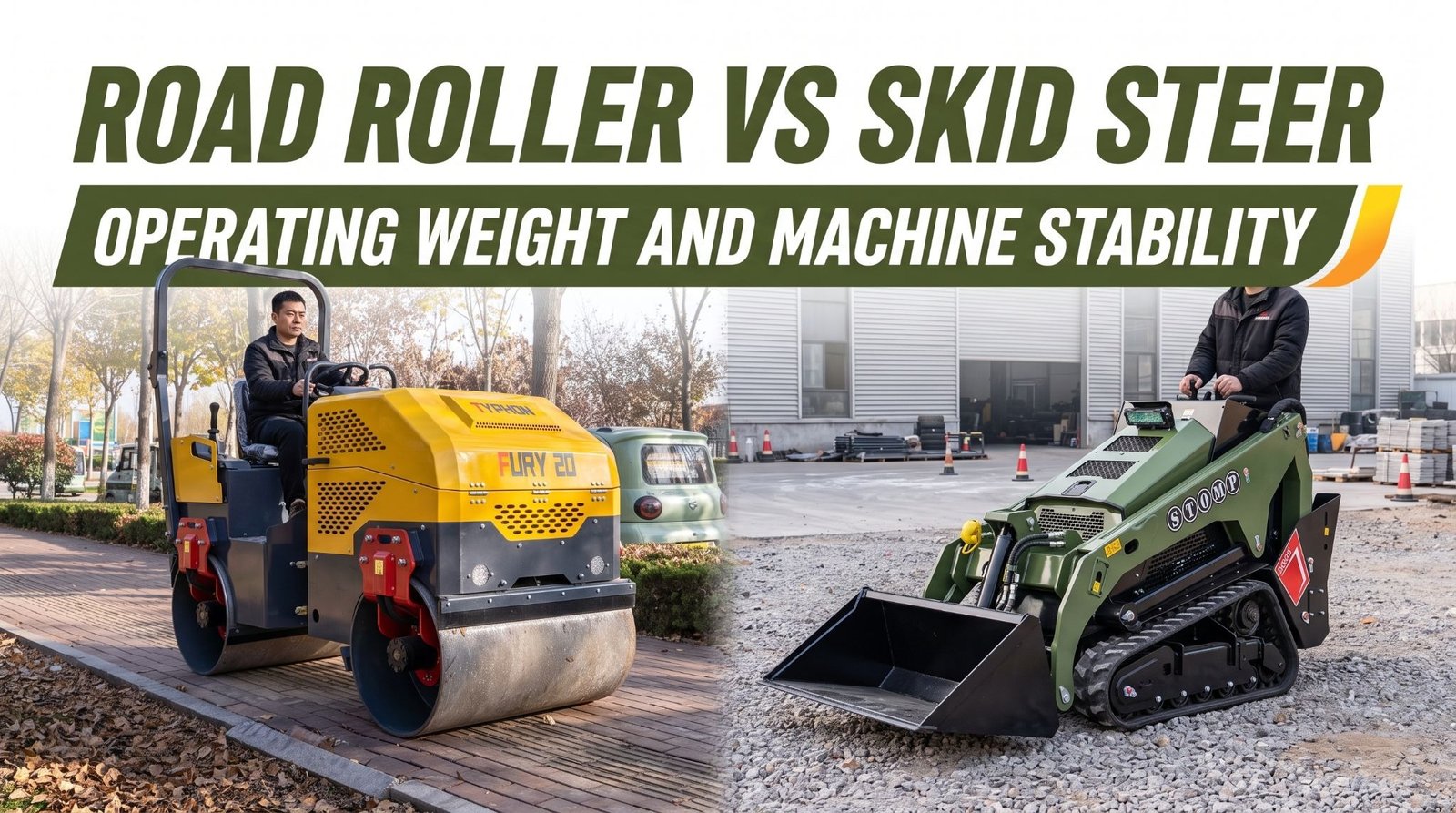
Mass distribution plays a direct role in how a road roller transfers force into the surface, while a skid steer depends on its overall weight to support traction and load stability. The roller concentrates a substantial portion of its mass through the drum, creating static loading against soil, aggregate, or asphalt during each pass. A skid steer distributes its operating weight across the chassis and tires, helping resist load-induced tipping forces as the loader arms raise, carry, and position material. Changes in bucket load and lift height can shift the center of gravity, making weight distribution particularly important during lifting and travel.
The performance effect of operating weight becomes clearer when each machine’s primary duty is considered. Drum weight and static linear load determine how much of a roller’s mass contributes directly to compaction, while a skid steer’s operating weight works alongside rated operating capacity, lift geometry, center of gravity, and ground conditions to maintain stability and traction. For this reason, operating weight should not be interpreted as a simple measure of machine size when comparing these two equipment types.
What Operating Weight Means for Each Machine
Operating weight is the total weight of a machine ready to work, including fluids and a standard operator, and it is one of the most telling figures on any spec sheet. For a road roller, that weight is largely the point. The machine is built heavy on purpose, because the mass pressing down through the drum is what firms the ground beneath it. A roller’s operating weight tells you a great deal about how much static compaction force it brings before vibration ever enters the picture.
For a skid steer, operating weight reads very differently. Here the figure describes a compact, agile machine designed to lift, carry, and maneuver, and the weight matters mostly for how the machine stays balanced while it works. A skid steer’s weight is spread across a short wheelbase, and much of the design effort goes into keeping that weight positioned so the machine stays stable while a load shifts its balance forward. The same number that signals raw compaction power on a roller signals stability and lifting capability on a skid steer, so reading operating weight well means knowing which job the weight is doing.
Key takeaway: Operating weight is the total working weight of a machine, but it serves compaction on a road roller and stability on a skid steer, so the same figure means different things on each.
Key Differences in How Each Machine Uses Its Weight
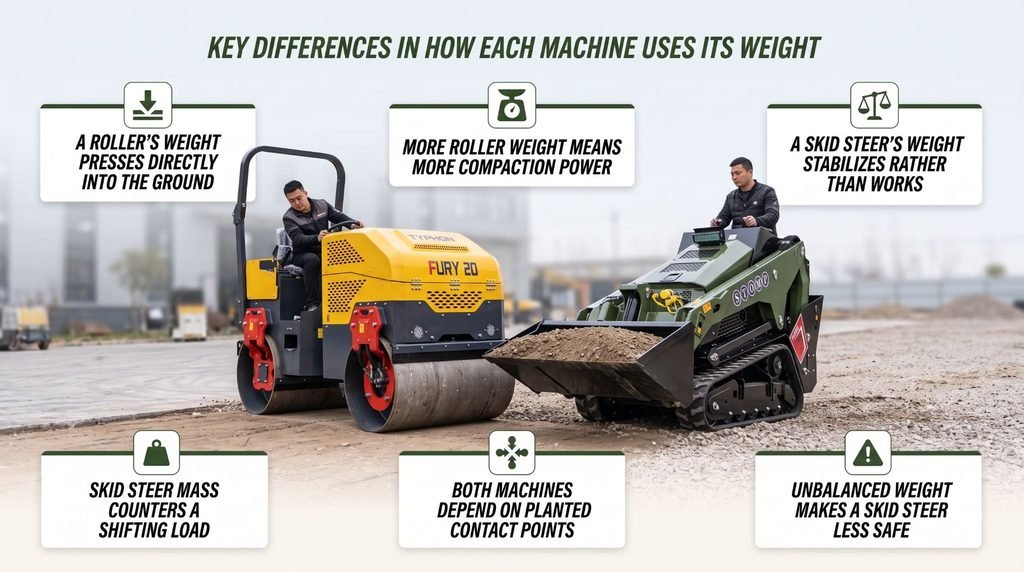
The clearest way to understand these two machines is to see that they treat weight as opposite tools. A road roller uses weight as a working force aimed directly at the ground. Every pound of that machine exists to press material down, and more weight generally means more compaction capability. The roller wants its mass concentrated through the drum and driven straight into the surface, because that downward force is the entire purpose of the work.
A skid steer uses weight as a stabilizing balance rather than a working force. Its mass is not meant to press on anything but to hold the machine steady while the loader arms do the real work out front. Where the roller wants weight pushed down into the ground, the skid steer wants weight positioned to counter a shifting load and keep all four contact points planted. This difference explains why the same spec means such different things. On a roller, more weight is a direct gain in performance. On a skid steer, weight is only useful when it sits in the right place relative to the load, and simply adding mass without balancing it would make the machine less safe, not more capable.
Key takeaway: A road roller uses weight as a downward working force for compaction, while a skid steer uses weight as a counterbalance for stability, so more weight helps one directly and only helps the other when properly positioned.
What Happens When Stability Is Compromised on Each Machine
Losing stability looks very different on these two machines, and understanding each failure helps operators avoid it. On a road roller, the most common stability concern is the drum beginning to bounce or hop, usually when vibration is too strong for the layer, or the machine working on a slope where its weight can shift and slide. A bouncing drum wastes compaction energy and can damage both the surface and the machine, while a roller operating across a steep grade risks sliding or, in the worst case, rolling. The machine’s heavy, low weight helps it stay grounded, but that same weight makes any loss of control on a slope serious.
On a skid steer, compromised stability usually means tipping. Overload the bucket, raise a heavy load too high, drive across a slope, or brake sharply with a full load, and the center of gravity can move outside the machine’s footprint, pitching it forward or sideways. Because a skid steer is compact and rides high relative to its footprint, it reaches that tipping point more readily than a heavier, lower machine. The consequences are immediate and dangerous, which is why load limits, smooth operation, and careful ground assessment matter so much. In both cases, the warning signs appear before the failure, and reading them is what keeps the work safe.
Key takeaway: A road roller loses stability through drum bounce or sliding on slopes, while a skid steer loses it by tipping when overloaded or raised too high, and both give warning signs before failure.
Practical Tips for Operators
Working either machine safely starts with respecting how it uses its weight. On a road roller, keep the machine on ground firm enough to support its mass and take slopes with real caution, since the heavy, low center of gravity that grounds the machine on flat ground becomes a liability on a grade. Watch the drum for bounce and ease off the vibration or adjust speed the moment it appears. Keep a steady travel speed with overlapping passes, and remember that the roller’s job is to drive weight into the ground, so let that weight do the work rather than rushing the machine through a lift it needs time to firm.
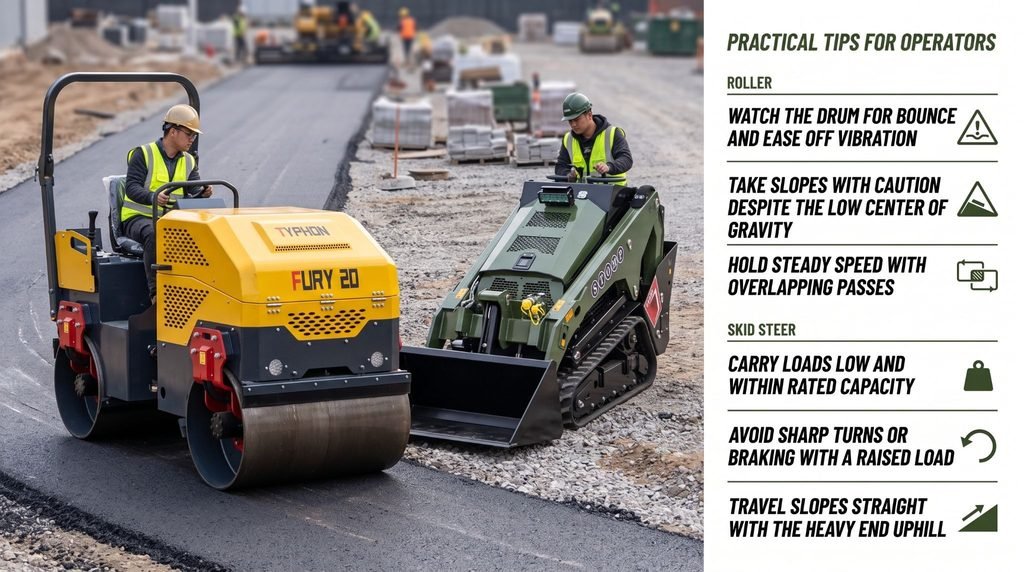
On a skid steer, the discipline centers on protecting the machine’s balance. Keep every load within the rated operating capacity and carry it as low as possible while traveling, raising it only at the point of dumping or placing. Move smoothly and avoid sharp braking or sudden turns with a load raised, since abrupt movements can shove the center of gravity past the tipping point. Approach slopes carefully, generally traveling straight up and down rather than across, and keep the heavy end of the machine pointed uphill for stability. Fit counterweights where the manufacturer calls for them, and always work from ground firm and level enough to keep all four contact points planted. These habits turn the machine’s weight into the steady base it is designed to be.
Key takeaway: Operate a road roller with caution on slopes and attention to drum bounce, and work a skid steer within its load limits with loads carried low and movements kept smooth, since both depend on respecting how the machine uses its weight.
How to Evaluate Specs When Choosing Between Them
Choosing between these machines, or picking the right size of either, begins with matching the operating weight to the job it must do. For a road roller, read the operating weight as a measure of compaction capability and set it against the materials and lift depths you actually work. Deep, heavy lifts of granular fill call for substantial weight, while lighter surface work needs far less, so anchor the choice to your real material rather than the biggest figure available. Weigh the static weight alongside the machine’s vibration and drum type, since together they determine how well it will compact your specific ground.
For a skid steer, read operating weight in partnership with the rated operating capacity, because the two together describe how much the machine can safely lift and how stable it stays doing it. Match that capacity to the loads you handle most, and consider how the machine’s weight distribution and design suit the ground and tasks in front of you. Think about the slopes you work, the height you lift to, and the attachments you run, since all of these test stability. For either machine, the most reliable check is a real-world one: put a candidate to work on ground like your own, compacting your material or lifting your loads, since watching how the machine uses its weight in your conditions reveals far more than any figure on a page.
Key takeaway: Read a road roller’s weight as compaction capability against your material and lift depths, and read a skid steer’s weight alongside its rated capacity for safe, stable lifting, then test either machine on ground like your own.
Conclusion
Operating weight tells two very different stories depending on which machine holds it. On a road roller, weight is the working force, pressing material together and setting how deep the machine can firm a layer, so more weight is a direct gain in compaction. On a skid steer, weight is a stabilizing balance, positioned to counter a shifting load and keep the machine planted, so placement matters far more than the raw figure. That single difference explains why the roller wants its mass driven straight into the ground while the skid steer wants its mass held steady against the load out front. Understanding it changes how you read the specs, how you operate each machine safely, and how you choose the right one for the work. The operations that get the most from either machine are the ones that recognize what the weight is really doing and respect it accordingly.
Frequently Asked Questions
Why does operating weight matter more for compaction on a road roller than on a skid steer?
A road roller uses its weight to press material and generate compaction force through the drum. More weight can increase ground pressure and compaction depth. A skid steer uses its weight mainly for stability and lifting balance rather than compaction. Therefore, operating weight represents compaction capability on a roller but stability and load balance on a skid steer.
What makes a skid steer more likely to tip than a road roller?
A skid steer has a compact footprint and higher center of gravity, which can shift forward or sideways when carrying a raised load. Overloading, sharp turns, braking, or driving across slopes can increase tipping risk. A road roller sits lower with weight concentrated near the ground, so its main stability concerns are sliding or drum bounce rather than load-induced tipping.
How do I choose the right size machine for my jobsite?
Match the machine to the work rather than simply choosing the largest model. For a road roller, consider operating weight, material, lift depth, vibration, and drum type. For a skid steer, compare operating weight with rated capacity, typical loads, lift height, and terrain. Testing the machine on similar material or loads can also confirm whether its size suits the job.