Currently Empty: $0.00

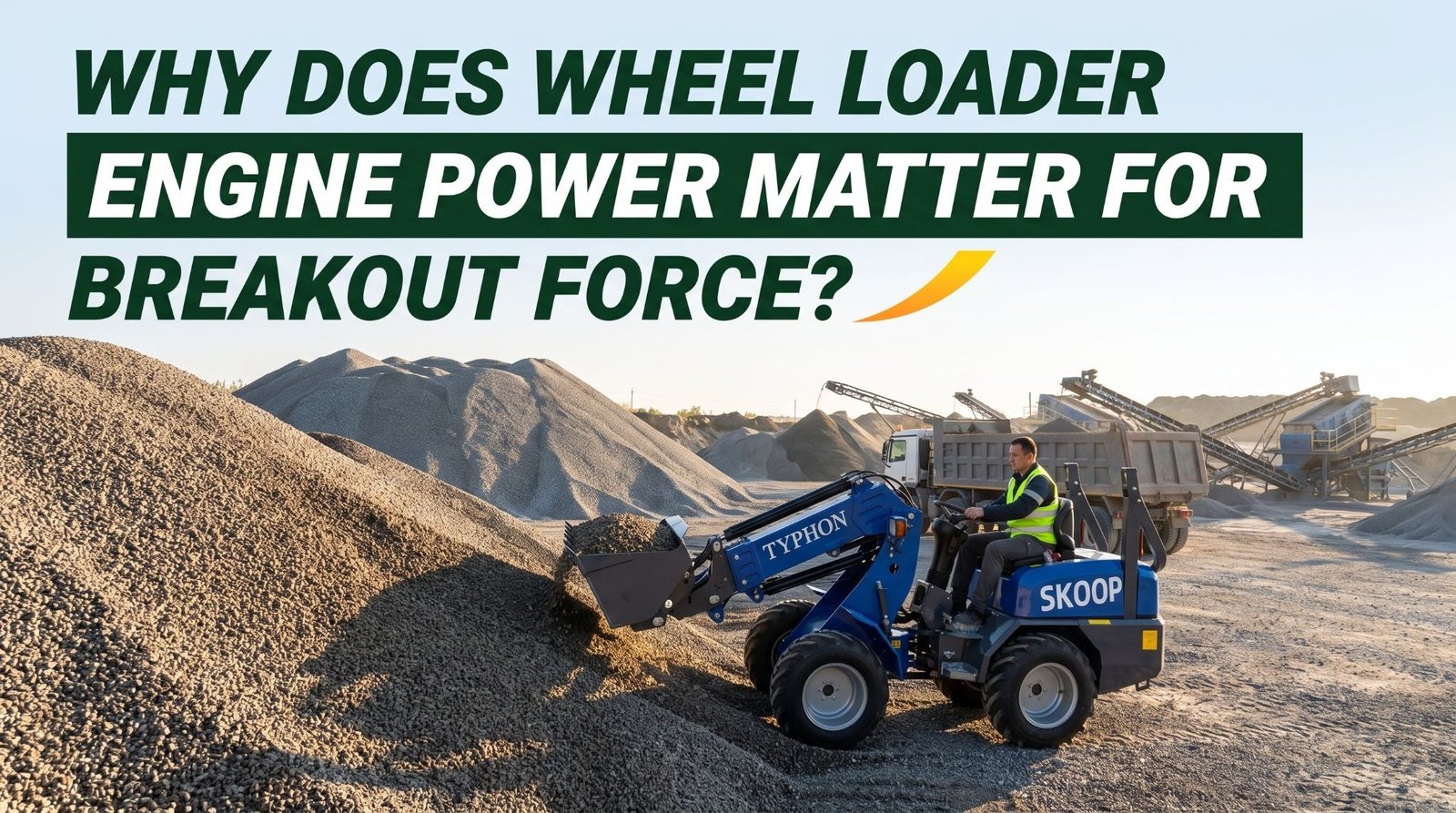
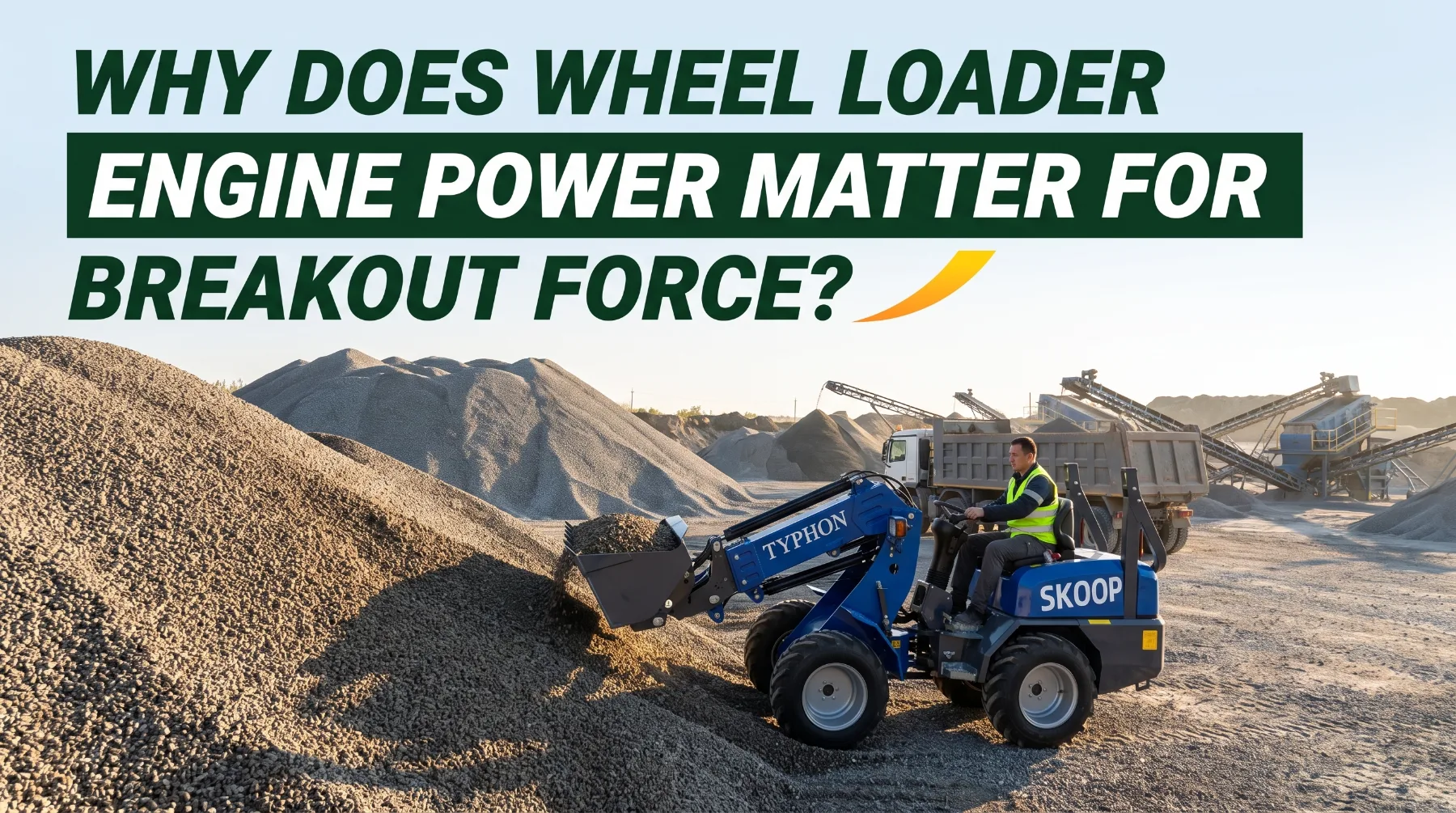
Why Does Wheel Loader Engine Power Matter for Breakout Force?
https://img.miniexcavator.org/ebay/Blog/class5/12thSep/WheelLoader-01.webp
A wheel loader’s breakout force depends on the combined performance of the engine, hydraulic system, and drivetrain. When the bucket enters a dense material pile, the hydraulic cylinders require sufficient pressure and flow to generate the force needed to curl the bucket and lift the load. The engine supplies mechanical power to the hydraulic pump, allowing it to maintain pressure as resistance increases. At the same time, the drivetrain must provide enough torque and traction to push the loader into the pile. If engine output is insufficient, the machine may lose engine speed or hydraulic response under peak demand, limiting its ability to penetrate dense material and fill the bucket efficiently.
Engine torque, horsepower, hydraulic pressure, pump capacity, and available traction must therefore be considered together when evaluating breakout performance. Torque is particularly important at lower engine speeds when the loader is crowding into a pile and resistance is high, while horsepower determines how much work the powertrain can sustain as hydraulic and drivetrain demands continue. Material density, bucket size, tire condition, ground surface, and operating technique also affect the force required during each loading cycle. The correct engine is not simply the one with the highest horsepower rating, but the one that provides enough power reserve for the hydraulic and drivetrain systems to maintain breakout performance under the actual material and duty conditions.
What Breakout Force Is and Why It Matters
Breakout force is the maximum upward force the bucket can exert to break material free from a pile or the ground. Picture the loader driving its bucket into a bank of packed aggregate, then curling and lifting to pry a full load loose. The force that does that prying, that first hard pull that separates the material and rolls it back into the bucket, is breakout force. It’s usually measured in pounds or kilonewtons, and it’s one of the truest measures of how a loader performs at the working face.
This spec earns its keep in nearly every task a wheel loader does. Loading dense material, digging into compacted ground, filling a bucket in a single clean pass, all of it leans on breakout force. A machine with strong, dependable breakout force fills the bucket quickly and moves on, so cycle times stay tight and productivity climbs. A machine short on breakout force claws at the pile, takes partial bites, and burns time and fuel making up the difference. In loading work, where a shift can run hundreds of cycles, that difference compounds into real money.
Key takeaway: Breakout force is the bucket’s power to pry material loose, and it directly sets how cleanly and quickly a wheel loader fills its bucket.
How Engine Power Connects to Breakout Force
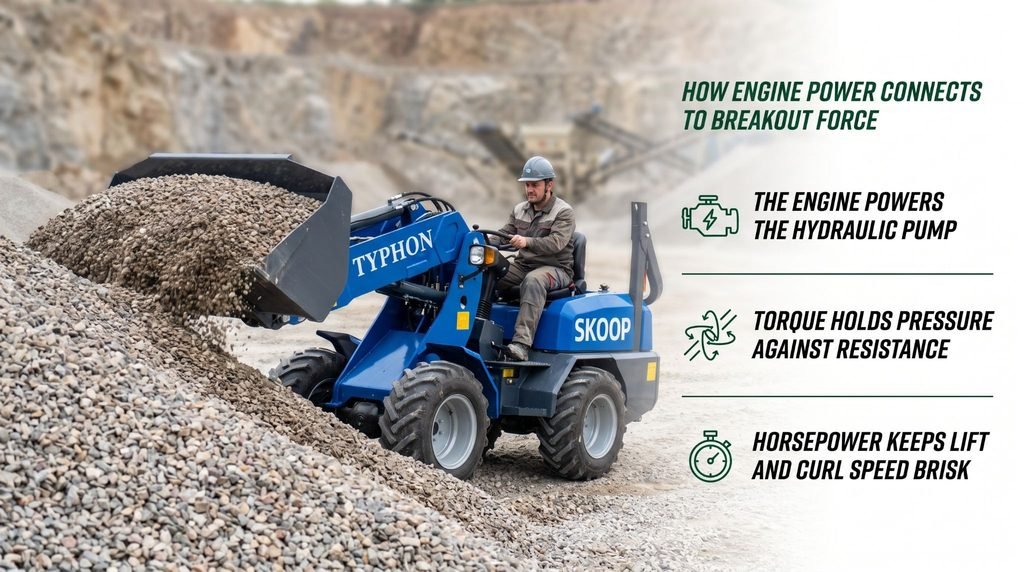
A wheel loader creates breakout force hydraulically, not mechanically through the engine directly. The engine drives a hydraulic pump, and that pump pressurizes the fluid that powers the lift and tilt cylinders. Those cylinders are what curl and raise the bucket to pry material free. So breakout force begins as engine output, gets converted into hydraulic energy, and finishes as the muscle at the cutting edge. The power the engine produces sets the ceiling on how much hydraulic force those cylinders can deliver.
Two qualities of engine output matter here, and they work as partners. Torque is the twisting force the engine produces, and it’s what lets the machine build and hold hydraulic pressure against heavy resistance. Horsepower describes the rate at which the engine can sustain that work over time, keeping lift and curl speeds brisk through a long shift. Hydraulic pressure sets the force the cylinders exert, and building that pressure under load draws directly on the engine. An engine with genuine output holds pressure and flow even as the bucket meets stiff resistance, so breakout force stays strong when you need it most. An engine short on power can’t hold that pressure, and the breakout force fades right at the face.
Key takeaway: Engine power drives the hydraulic pump that curls and lifts the bucket, so torque and horsepower together set how much breakout force the machine can produce.
How Traction and Drivetrain Effort Combine With Hydraulic Force
Breakout force at the bucket is only part of the story. Before the cylinders can pry material loose, the loader has to drive the bucket into the pile and stay planted while it digs. That takes traction and drivetrain effort, and the engine powers those too. The same engine that feeds the hydraulic pump also drives the wheels, so it’s doing two demanding jobs at the exact moment the work turns hard.
Here’s how they combine at the face. The operator drives the bucket into the material, and the drivetrain supplies the forward force, the rimpull, that crowds the cutting edge into the pile. At the same time, the hydraulics curl and lift to break the load free. If the engine can feed both the wheels and the cylinders together, the loader crowds in and pries up in one smooth, powerful motion. If it can’t, something gives: the wheels spin without gripping, or the bucket stalls mid-curl. An engine with real reserve carries both loads at once, which is why a loader’s digging performance is never about the hydraulics alone. Traction and hydraulic force have to arrive together, and the engine is the common source of both.
Key takeaway: The engine powers both the drivetrain that crowds the bucket into the pile and the hydraulics that pry the load loose, so it must feed both demands at the same moment.
The Role of Engine Torque in Crowding the Bucket
When the bucket meets dense, compacted material, torque is the quality that decides whether the machine powers through or bogs down. Crowding into a tight pile is a low-speed, high-resistance task, and that’s precisely where torque does its best work. Strong torque lets the engine hold its output as resistance climbs, driving the bucket deeper into the material and building the hydraulic pressure needed to pry a full load free, all without lugging down.
Pay particular attention to how torque behaves at lower engine speeds. Crowding and breakout happen at the low end of the range, not at full throttle, so an engine that holds strong low-end torque powers into the pile and keeps working rather than stalling at the first hard resistance. This is often the difference you feel between two loaders on the same material. One drives in, curls, and lifts a heaping bucket in a single confident pass. The other hesitates, spins, and settles for a half-load. The torque behind the bucket is frequently the reason one machine works with authority and the other labors.
Key takeaway: Low-end torque is what drives the bucket into dense material and holds hydraulic pressure against resistance, so it’s the truest engine predictor of strong breakout performance.
What Happens When Engine Power Is Insufficient
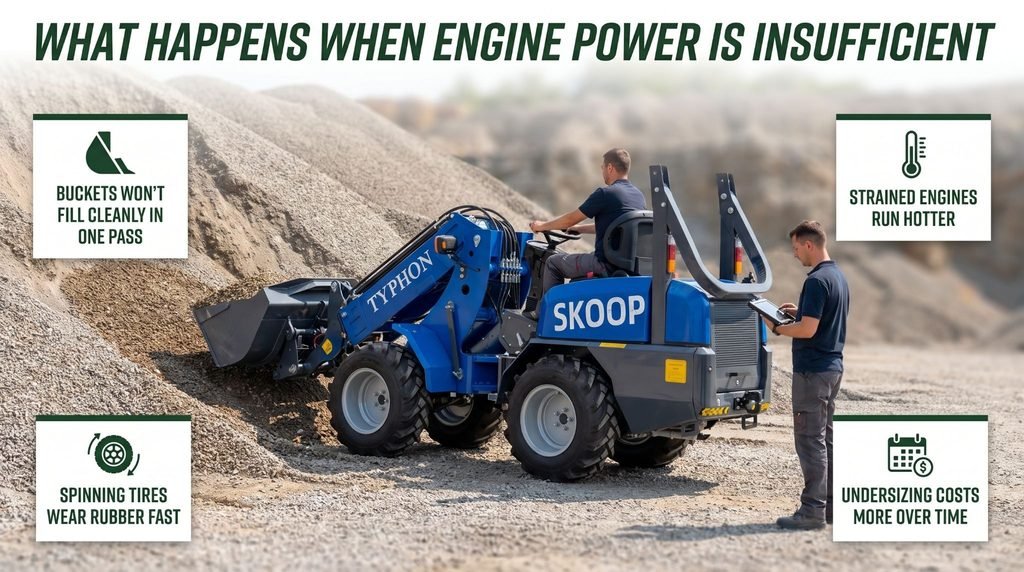
An underpowered loader reveals itself the moment a full bucket meets a hard pile. The clearest symptom is a bucket that won’t fill cleanly. The machine drives in, the hydraulics strain, and the load breaks free only partway, so the operator backs out and takes another bite, turning a one-pass job into two or three. Cycle times stretch, fuel burn climbs, and the loader never delivers the throughput its bucket size promised. Operators often work around it by digging softer parts of the pile or taking smaller bites, and productivity quietly erodes all shifts.
The damage runs deeper than lost pace. An engine forced to run near its ceiling all day generates more heat, pushes hydraulic fluid past its efficient temperature range where it transmits power poorly and breaks down faster, and ages the pump, seals, cooling system, and drivetrain ahead of schedule. Tires suffer too, since a machine that can’t crowd cleanly tends to spin its wheels against the pile, wearing rubber fast. A chronically overworked loader wears out faster than its hour meter suggests, so a lower purchase price turns into a higher lifetime cost. In demanding loading work, undersizing is usually the costlier mistake, because the strain compounds every single shift.
Key takeaway: Too little engine power means partial bucket loads, longer cycles, wasted fuel, and accelerated wear, so undersizing quietly raises the true cost of the machine.
How Material Type and Duty Cycle Affect Engine Demand
Material type is the most direct driver of how much breakout force, and therefore engine power, a job requires. Loose material like sand, dry topsoil, or a freshly dumped stockpile offers little resistance, so the bucket fills easily and the engine barely notices. Dense and compacted material is a different matter. Packed clay, wet aggregate, bank-run gravel, and blasted rock fight back hard, forcing the hydraulics to build high pressure and the drivetrain to crowd with real force. The denser and more compacted the material, the more breakout force the job demands, and the more engine power it takes to deliver it. If you want to predict a loader’s power needs before you buy, the material you’ll dig tells you most of the story.
Duty cycle multiplies that demand across time. A loader making occasional loads with long pauses gives the engine frequent breaks, so peak draws stay brief and manageable. A machine running near-continuous loading cycles through a full shift keeps the hydraulics and drivetrain loaded almost constantly, leaving the engine little chance to ease off. Stack dense material onto a high-intensity duty cycle, think steady truck loading or feeding a crusher hour after hour, and several demands hit the engine at once, over and over. Only a machine with genuine headroom carries that combined, repeated load without losing breakout force or bogging down. When you size engine power, the honest question isn’t what the loader digs occasionally, but what it digs, how hard, and how often across the whole shift.
Key takeaway: Dense material raises the breakout force each cycle demands, and a heavy duty cycle repeats that demand for hours, so both must be weighed together when judging the power a loader needs.
Conclusion
Engine power strongly influences wheel loader breakout performance because it must supply power to both the hydraulic system and drivetrain. Hydraulic cylinders and linkage generate breakout force, while the drivetrain provides traction to push into the material. Sufficient horsepower and low-speed torque help maintain hydraulic pressure and wheel torque under heavy resistance. If engine output is too low, the loader may have slower hydraulic response, reduced bucket fill, longer cycles, and higher operating stress. Engine sizing should therefore consider hydraulic flow and pressure, drivetrain capacity, operating weight, bucket size, material density, traction, and duty cycle rather than horsepower alone.
Frequently Asked Questions
What’s the difference between breakout force and engine power on a wheel loader?
They are closely related but measure different things. Breakout force is the maximum force the bucket can apply to pry material loose, while engine power provides the energy needed to create that force through the hydraulic system. Torque helps the engine maintain hydraulic pressure under resistance, while horsepower supports sustained lifting and bucket movement. A strong breakout-force rating is most useful when the engine and hydraulic system can maintain it under real working loads, so compare both specifications together.
Is torque or horsepower more important for wheel loader breakout force?
Both matter, but torque is especially important during low-speed, high-resistance work. Crowding a bucket into dense material requires the engine to maintain output without lugging down, allowing the hydraulic system to build and hold pressure. Horsepower helps sustain lift and curl speeds and maintain productive cycle times. For breakout work, look for a balance of strong low-speed torque and sufficient horsepower for continuous operation.
How do I know if a wheel loader has enough engine power for my work?
Start with your heaviest regular tasks and the materials you handle. Dense clay, gravel, and blasted rock require more breakout force than loose materials, while continuous truck loading or crusher feeding demands sustained power. Compare the loader’s breakout force with the material and check that the engine provides enough torque and horsepower to maintain performance under load. If possible, test the machine on similar material and at your normal working pace to confirm it fills the bucket and maintains force without excessive engine lugging.