
Electric Scissor Lift Platform Height and Working Reach
An electrical contractor wins a fit-out job in a two-story office atrium. The work involves hanging cable tray and mounting new pendant fixtures about 28 feet above a polished lobby floor. The project manager rents an electric scissor lift with a listed “working height” of 32 feet, expecting plenty of margin. On the first morning, the crew finds three problems. The platform tops out several feet below the fixture line, so technicians must reach overhead with heavy components. Part of the cable tray runs above a fixed reception counter, and the scissor lift can’t get close enough to reach over it. The machine also clears the service door with less than an inch to spare. None of these problems came from a faulty machine. They came from misreading what the specifications actually described.
Electric scissor lifts provide vertical access for maintenance, construction, and facility operations. Maximum platform height and working reach help determine whether a model can reach the work area. These terms describe different measurements, and manufacturers don’t always define them the same way. When buyers and rental customers compare figures without checking their definitions, the wrong machine often reaches the site.
Understanding Maximum Platform Height
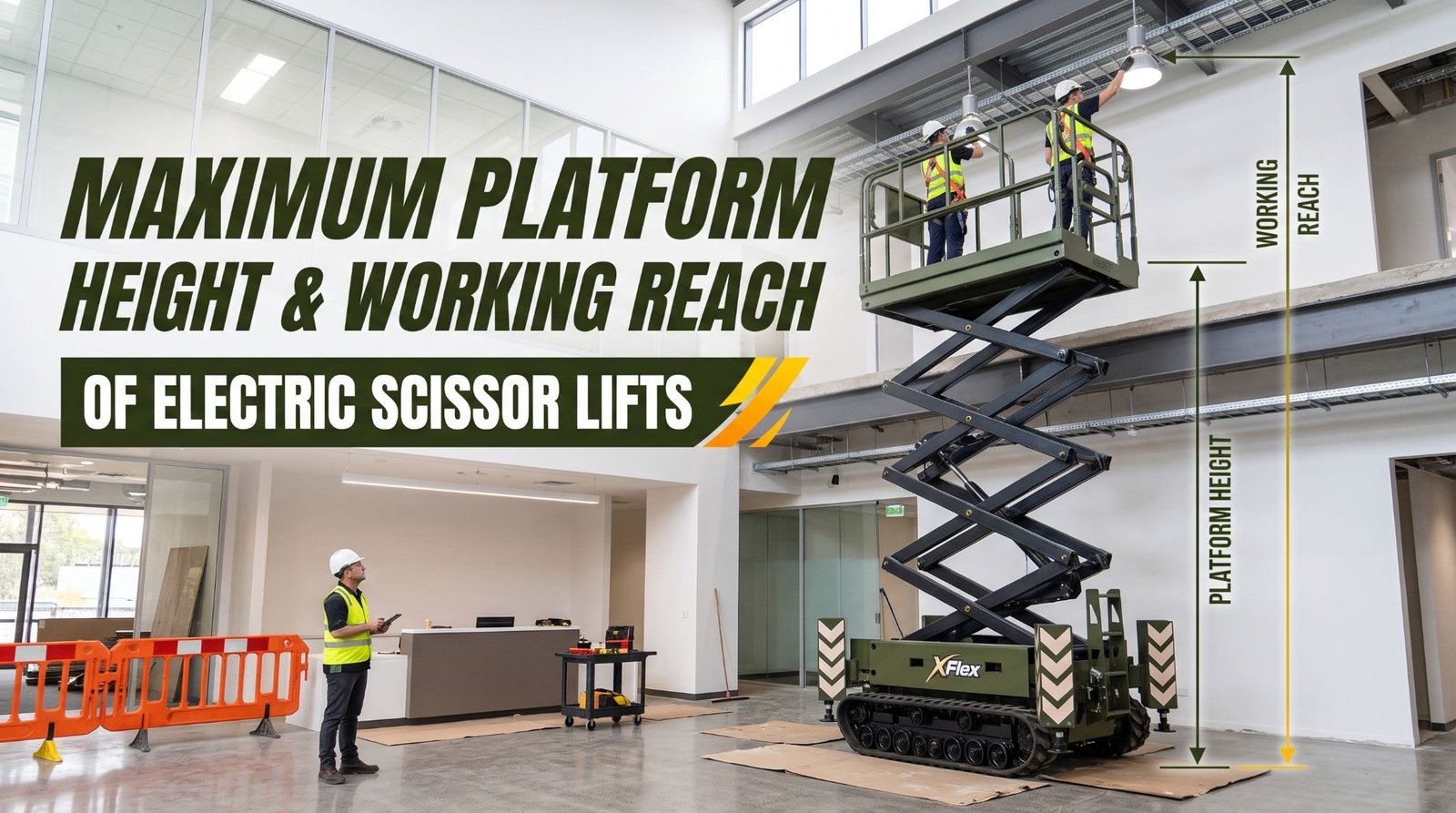
Maximum platform height measures the distance from the ground to the platform floor when fully raised on level ground. It is a fixed specification that shows the operator’s actual working elevation, unlike working height, which estimates operator reach.
When planning, consider ground conditions, overhead clearance, and guardrail height. Also check whether the extension deck matches the main platform height and verify the specification for the exact make, model, and configuration, as measurements can vary between versions.
The required platform height depends on the work location and the operator’s working position. Workers should be able to complete the task with both feet flat on the deck and their hands at a comfortable height, usually between chest and head level. Overhead work at full stretch reduces control, increases fatigue, and tempts workers to lean over guardrails or stand on midrails. To find the platform height you need, measure from the floor to the exact component you will service or install, subtract a comfortable working distance for the operator (often 4 to 5 feet depending on the task), measure the clearance above the work point including beams, ductwork, and sprinkler piping, and then choose a lift whose maximum platform height reaches the working level with a sensible margin, without bringing guardrails into contact with overhead structures. The most common mistake is choosing a lift by its largest published number. A better approach is to plan around platform height and comfortable working positions, then confirm overhead clearance.
Key takeaway: Maximum platform height is a fixed machine specification measured from the supporting surface to the raised deck. Verify it for the exact model, and select a lift that places operators at a comfortable working level below overhead structures.
Horizontal Reach and Scissor Lift Design
A scissor lift raises its platform through a crisscrossing stack of steel arms. As the arms extend, the platform rises straight up over the chassis. That design delivers stable vertical elevation and a generous platform area, but it provides limited horizontal outreach. The platform stays directly above the machine’s base. To reach a work point, the lift itself must be driven underneath or alongside it. If something blocks the floor below the work area, the scissor lift can’t get there.
Many electric scissor lifts have a roll-out extension deck that adds horizontal reach toward walls or work surfaces. Extension decks may have lower weight limits, occupant restrictions, and a fixed extension direction. Always lock the deck before use and check the capacity decal and operator’s manual for model-specific limits.
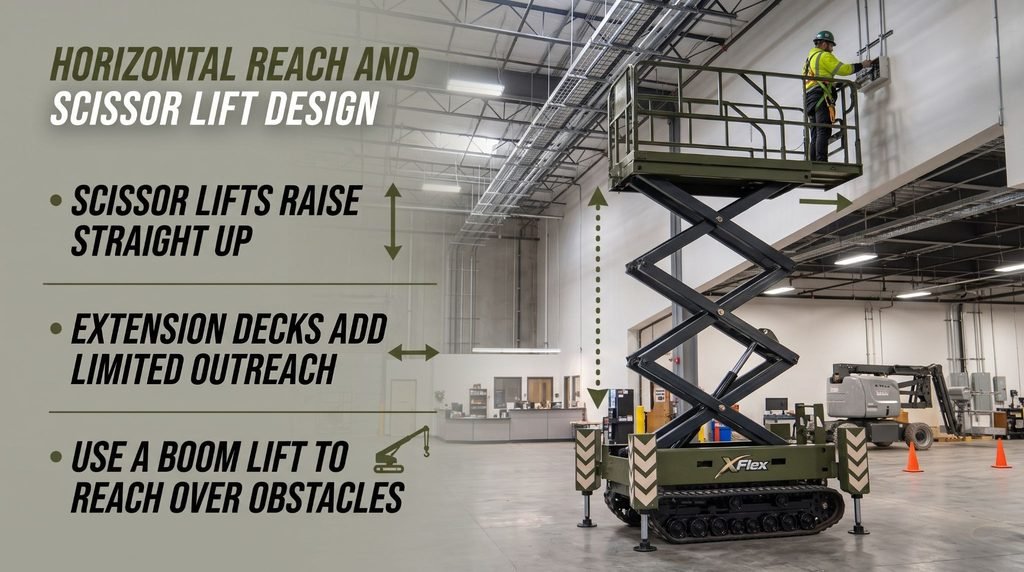
The term “working reach” isn’t standardized. Depending on the source, it may refer to the estimated vertical reach above the platform, the horizontal distance gained with the extension deck, a combined estimate of vertical and horizontal access, or another measurement specific to that manufacturer. Ask the manufacturer or rental provider to define the term before relying on it.
When work sits above an obstacle or away from accessible floor space, a boom lift may be more suitable. Boom lifts use an articulating or telescopic arm that extends up and out from the base. A scissor lift moves straight up and stays directly above its chassis, with horizontal reach limited to what an extension deck can add. A boom lift extends both upward and outward, giving it substantial horizontal reach and the ability to reach up and over obstacles. Scissor lifts typically offer a larger deck that can hold multiple workers and materials, while boom lift baskets are usually smaller with lower capacity. In practice, scissor lifts excel at ceiling work, lighting, HVAC, drywall, and general maintenance over open floor areas, while boom lifts are the better choice for work above counters, equipment, fixed seating, or other structures that block direct floor access. Some projects need both. A scissor lift may handle open floor areas while a compact boom lift reaches sections above fixed equipment or seating.
Key takeaway: Scissor lifts provide primarily vertical elevation, with limited horizontal outreach through extension decks. Clarify what the manufacturer means by “working reach,” and choose a boom lift when the work requires substantial outreach or access over obstacles.
Platform Height Versus Working Height
Working height is an estimated reach height, and it’s the figure that causes the most confusion. Manufacturers calculate it by adding an assumed operator reach to the maximum platform height. It shows roughly how high a typical worker can reach while standing on the raised platform. In the United States, many manufacturers add about 6 feet to the platform height. In Europe and other regions, a common convention adds about 2 meters. Definitions vary, so always check how the manufacturer defines working height for the specific machine.
There are four key height figures to understand when comparing scissor lifts. Maximum platform height measures from the ground to the raised deck surface and serves as your primary planning figure for where the operator will actually stand. Working height adds an assumed operator reach on top of platform height and should be treated as a general reference only, not a guaranteed figure. Stowed height is the machine’s height with the platform fully lowered, which determines whether the lift can pass through doors and under obstructions during travel. Finally, guardrail height above the deck tells you how far the rails extend above the platform floor, which matters for overhead clearance as the platform rises.
Working height assumes an average reach with arms extended overhead, and real tasks rarely match that assumption. A shorter operator, a task that needs both hands at chest level, or a heavy fixture held overhead can reduce practical reach considerably. Consider a light fixture mounted 26 feet above the floor. A lift with a 26-foot working height might seem suitable, but its platform may reach only about 20 feet. The technician would have to work fully extended overhead while handling a fixture and tools. A lift with a platform height near 21 or 22 feet would let that technician work at a stable, controlled position.
When comparing scissor lifts, check whether the listed figure refers to platform height or working height, the reach assumptions, optional equipment, and regional measurement standards. Compare platform heights first because they provide a consistent basis across manufacturers, while working height calculations may vary.
Key takeaway: Working height adds an estimated operator reach to platform height, and manufacturer definitions vary. Compare machines using maximum platform height, and treat working height as a general reference rather than a guarantee.
Indoor Access and Machine Dimensions
Electric scissor lifts are widely used indoors because they produce no exhaust at the point of use and run quietly. A lift with the right height and reach still has to travel from the loading area to the work position and fit there safely.
Overall width determines whether the lift can pass through doors, aisles, and gaps between equipment. Measure the narrowest points along the entire route and allow clearance on both sides to prevent damage.
Stowed height determines whether the lift can pass under doorways, mezzanines, conveyors, and overhead piping. Some models have folding guardrails to reduce travel height, but they must be locked upright before elevation. Turning radius also matters, so check the inside and outside turning dimensions at corners and aisle intersections to ensure the lift can maneuver safely.
Indoor work areas are full of overhead hazards. Before elevating, check for beams, joists, and purlins, light fixtures and suspended ceilings, ductwork, cable trays, and conduit, sprinkler heads and branch lines, overhead doors and their tracks, and crane rails or overhead conveyors. Raise the platform slowly as it approaches overhead structures, keep heads and hands inside the guardrails, and use any secondary guarding or entrapment protection fitted to the machine.
Electric scissor lifts also concentrate weight through relatively small tire contact areas. Confirm that floors, mezzanines, and elevated slabs can support the machine’s operating weight and battery demand, along with its full platform load. Choose non-marking tires for finished floors, and use floor protection where required. Before sending any lift indoors, compare overall width against the narrowest passage on the route, confirm stowed height clears the lowest header or obstruction, verify turning radius suits every corner, check that combined platform height and guardrail height clears overhead structures at the work position, and confirm floor and mezzanine load ratings can handle the machine’s operating weight plus the full rated platform load.
Key takeaway: Compare overall width, stowed height, and turning space with every point on the route, check overhead structures at the work position, and confirm floor load ratings before an electric scissor lift goes to work indoors.
Platform Capacity and Operating Conditions
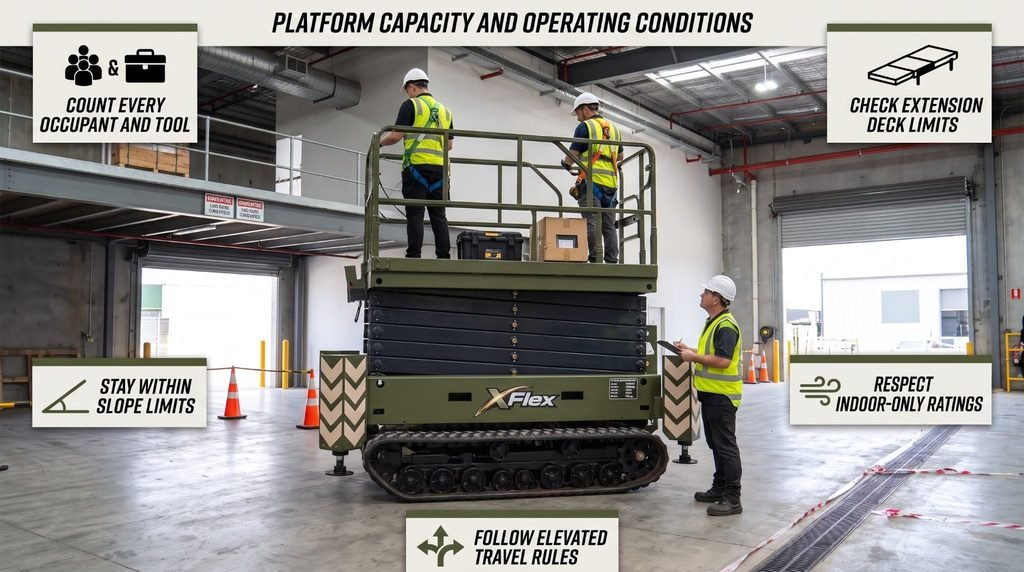
Rated platform capacity is the maximum combined load the manufacturer permits under specified conditions. It covers every occupant including the operator, all PPE, harnesses, tool belts, and clothing, hand and power tools and equipment cases, permitted materials, fixtures, and parts, and any approved accessories carried on the platform. The capacity decal lists the total rated load and the maximum number of occupants. Some lifts also list separate ratings for indoor and outdoor use, along with a lower limit for the extension deck. Every limit that applies must be respected.
Before elevating, total the estimated load by adding every occupant’s weight with their gear, all tools and equipment, and any materials or fixtures going up. Compare the total with the rated capacity for the exact configuration, including any extension deck limit. If the load approaches the limit, reduce materials and make additional trips. Place heavy items evenly across the deck and keep materials within the platform footprint. Secure loose items so they can’t roll or fall. Never hang tools or materials from guardrails, and never use the platform to transport loads that belong on a forklift or material lift.
Before raising the platform, ensure the floor is firm, level, and within the manufacturer’s slope limits. Check for drains, pits, weak covers, dock edges, and debris. Tilt sensors and pothole protection help improve safety, but they do not replace ground inspections. Never bypass tilt or overload warnings.
Most slab-style electric scissor lifts are designed for indoor use and are not rated for wind exposure. For outdoor work, choose an approved model and follow its wind and capacity limits. Check whether the lift permits driving while elevated, as travel restrictions vary by model. Operators must also be trained on the specific machine, including its controls, load limits, alarms, and emergency lowering procedures.
Key takeaway: Rated platform capacity covers every occupant, tool, and material, with separate limits for extension decks and outdoor use where specified. Confirm ground conditions and slope limits, respect tilt and overload alarms, and follow the manufacturer’s rules for elevated travel.
Battery Runtime and Charging
Battery runtime depends on capacity, age, and operating conditions. Frequent lifting, long travel distances, heavier platform loads, cold temperatures, rough floors, and onboard accessories all increase energy consumption. A lift used for light maintenance may last a full shift, while intensive lifting and frequent travel may require recharging earlier.
Electric scissor lifts commonly use one of three battery types. Flooded lead-acid batteries are widely used and cost-effective but require regular watering, ventilated charging, and full charge cycles. Sealed lead-acid batteries, such as AGM types, reduce watering needs but still benefit from proper charging practices. Lithium-ion batteries typically cost more upfront but often support opportunity charging, require no watering, and maintain steadier power as they discharge. Confirm the battery type and capacity for the exact configuration, since options vary by model.
Good charging habits keep the lift available when crews need it. Charge at the end of each shift, or during breaks where the battery type allows. Plan charging locations near the work area with a suitable electrical supply, use only the charger supplied or approved by the manufacturer, and confirm that the charger input matches the available outlet voltage. Avoid running batteries to full depletion when the manufacturer advises against it, and allow lead-acid batteries to complete their full charge cycle. On multi-shift or long-day projects, consider whether a second machine or a battery option with faster charging suits the schedule better.
Lead-acid batteries can release hydrogen gas during charging. Charge them in well-ventilated areas, away from sparks, open flames, and other ignition sources. Keep the area clear of combustible materials, and follow the manufacturer’s charging instructions. Include battery and electrical checks in routine inspections: examine terminals and cables for corrosion and damage, check electrolyte levels on flooded batteries and add water only as directed, keep battery tops clean and dry, inspect the charger cord and plug for damage, watch the battery indicator and report unusual discharge rates, and follow the manufacturer’s schedule for electrical system inspection. Combine these checks with the full pre-use inspection of guardrails, controls, emergency stops, emergency lowering, alarms, tires, and hydraulics.
Key takeaway: Battery runtime depends on capacity, condition, lift cycles, travel, load, and temperature. Plan charging around the work schedule, charge safely in ventilated areas, and inspect batteries and electrical components as part of routine maintenance.
Conclusion
Selecting the right electric scissor lift requires understanding how its specifications relate to the work environment. Maximum platform height indicates how high the platform rises, while working height includes an estimated operator reach that varies by manufacturer. Scissor lifts primarily provide vertical elevation with limited horizontal outreach, so tasks requiring access over obstacles may need a boom lift instead. Overall width, stowed height, turning space, and overhead obstructions determine whether the machine can reach the work area indoors. Rated platform capacity, floor conditions, slope limits, and elevated travel restrictions are also essential for safe operation, while battery capacity and charging arrangements affect productivity throughout the shift. Project planning should begin with measuring work heights, overhead clearance, and floor-level obstacles at each location. Doorways, aisles, and turning areas along the travel route should also be checked, and the combined weight of operators, tools, and materials must remain within the rated capacity. Model-specific specification sheets should confirm platform height, stowed dimensions, capacity, and battery details. Operators must also receive appropriate training and machine-specific familiarization before using the lift, helping ensure the selected equipment suits the site and the work can proceed safely and efficiently.
Frequently Asked Questions
Is platform height the same as working height?
No. Platform height is the distance from the supporting surface to the raised deck. Working height adds an estimated operator reach, often about 6 feet in the United States, though definitions vary by manufacturer and region. Plan around platform height and comfortable working positions.
Can a scissor lift reach horizontally over an obstacle?
Traditional scissor lifts provide primarily vertical elevation directly above the chassis. Extension decks add limited horizontal reach in one direction. When work sits above counters, equipment, seating, or other obstacles, a boom lift may be more suitable.
Does maximum platform height determine suitability by itself?
No. Platform capacity, overall width, stowed height, turning space, overhead clearance, floor strength, and ground conditions all affect whether a lift suits the job. Battery runtime and indoor or outdoor ratings matter as well.
What affects electric scissor lift runtime?
Battery capacity and condition, workload, lift cycles, travel distance, platform load, and temperature all influence operating time. Cold conditions and frequent elevation can shorten runtime noticeably. Plan charging around your schedule and follow the manufacturer’s charging and maintenance instructions.