
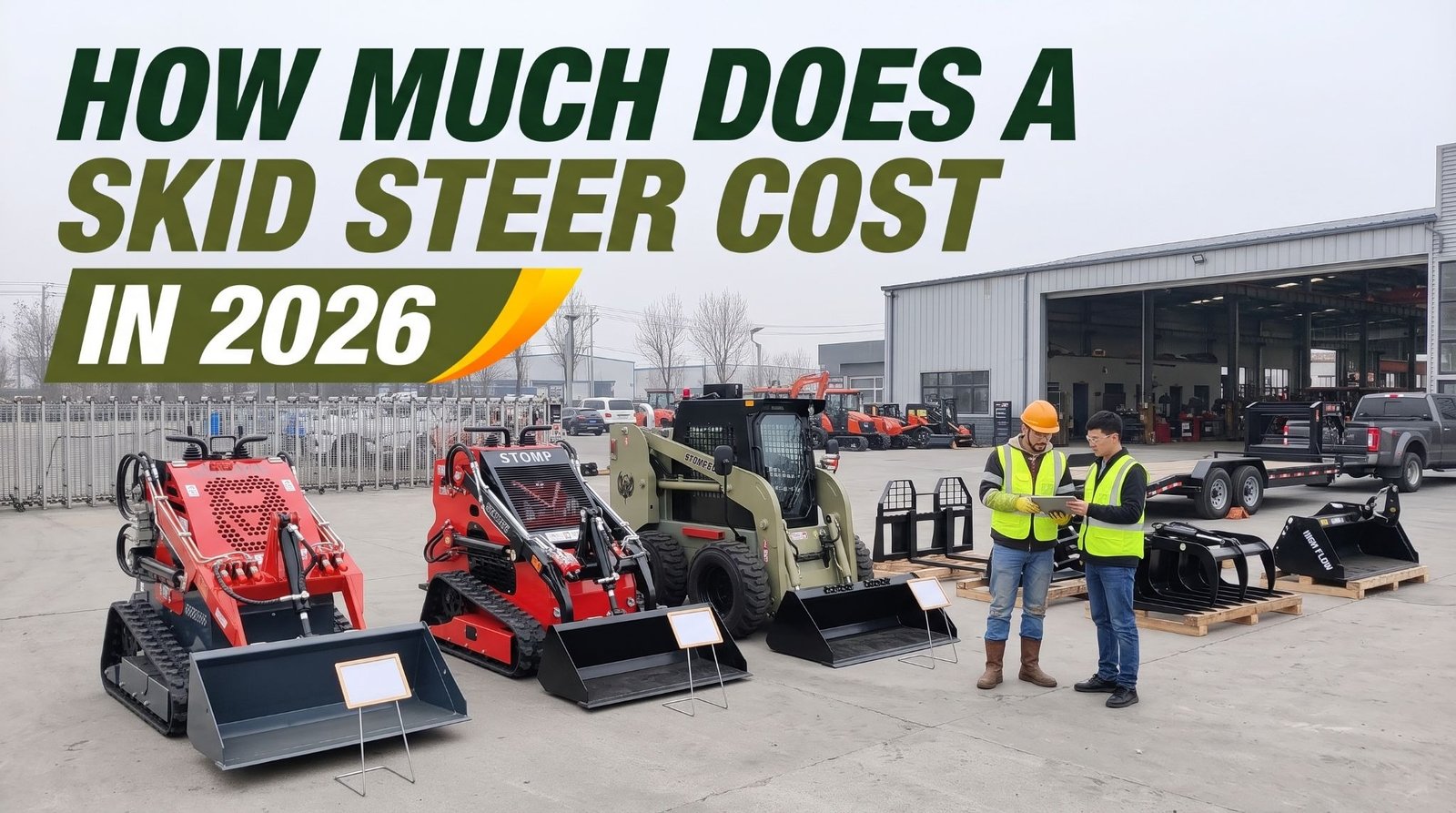
How Much Does a Skid Steer Cost in 2026
A skid steer quote can look simple. A dealer lists a machine at $58,000, a used listing shows a similar model at $34,000, and a rental yard quotes $1,200 for the week. Each number answers a different question, and none of them shows what the machine will cost your business over the next five years.
The real cost of a skid steer includes the purchase price, plus the attachments that make it productive and the financing that spreads the payment out. It also includes delivery, fuel, filters, oil, tires or tracks, insurance, repairs, and the downtime when the machine sits in the shop instead of earning money. A machine that looks inexpensive on day one can become the costly choice if it can’t run your attachments, needs a major repair in its first season, or sits idle most of the year. Contractors, landscapers, and small business owners who look at the full picture make better decisions. They choose machines sized for their actual work, pay for hydraulic capability they will use, and know when renting, leasing, or buying used makes more financial sense than buying new. The price ranges in this guide reflect general 2026 market levels. Actual prices vary by brand, region, dealer, configuration, and market conditions, so always request current written quotations before making a decision.
Compare Purchase Prices by Machine Category
Skid steers are usually grouped by rated operating capacity, the load the manufacturer approves the machine to carry under specified conditions. Capacity closely tracks machine size, engine output, and price, so it is the most practical starting point for comparing costs.
Several options can add thousands of dollars to the base price within any category, including an enclosed cab with heat and air conditioning, joystick or electrohydraulic controls, high-flow auxiliary hydraulics, two-speed travel, ride control, backup cameras, and tracks instead of wheels. Consider a landscaping company choosing between two machines. A compact model at $26,000 handles mulch, small pallets, and light grading. A mid-size model at $52,000 handles full pallets of pavers, a trencher, and snow pushing in winter. If the crew regularly moves pallets weighing 2,000 pounds or more, the compact machine can’t do the work safely regardless of how attractive the price looks. Rated operating capacity, not price, should set the minimum category.
Key takeaway: Start with the rated operating capacity your work requires, then compare prices within that category. Cab, controls, hydraulics, and travel options can move a machine across price ranges, so request quotes based on the exact configuration you need.
Evaluate New and Used Equipment Value
Used skid steers can deliver real savings, but only when the machine’s condition supports the price. Used machines generally sell from $5,000 to $85,000 or more, with lower-hour mid-size machines in good condition often falling in the $20,000 to $40,000 range. A new machine brings the latest engine and control technology, warranty coverage, a known history, and dealer support, though at a higher upfront cost and faster depreciation. A used machine offers a lower purchase price and slower depreciation, but the trade-off is uncertainty about maintenance history.
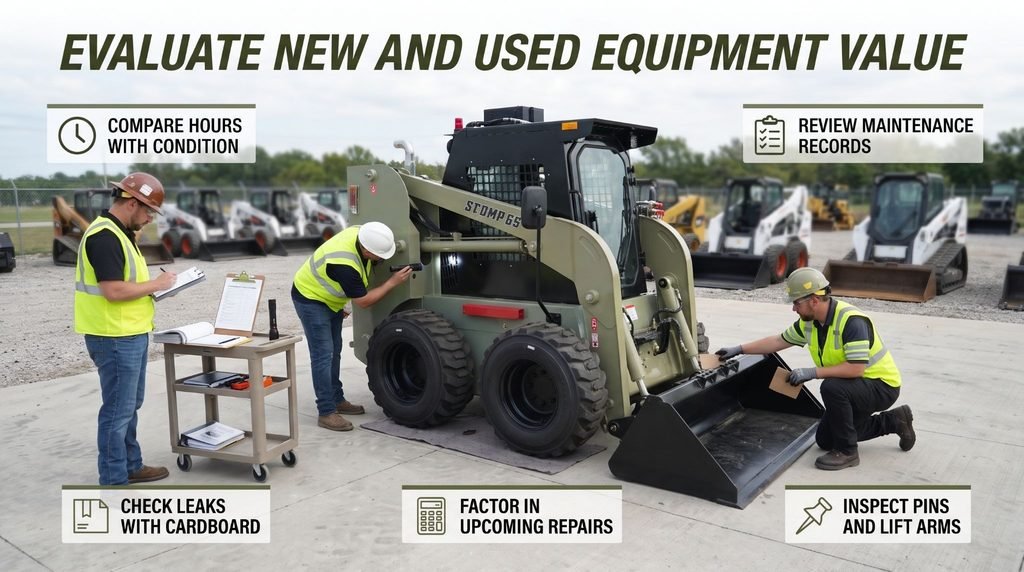
Review the machine’s records first, then inspect it in person or have a qualified technician do so. Check operating hours against age and condition, listen for engine knock and look for excessive smoke, test lift and tilt speed and confirm the arms hold position without drifting, check lift arm pins for play and cracked welds, test travel in both directions, inspect tires or tracks for wear and exposed cords, and confirm the attachment plate locking levers engage fully. Also inspect the ROPS/FOPS structure, seat belt, and interlocks for any damage or tampering.
Never use your hand to search for a hydraulic leak. Fluid escaping through a pinhole under pressure can penetrate skin and cause an injection injury that requires immediate surgical treatment. Use cardboard or wood to locate leaks, and wear gloves and eye protection. Before any inspection near the lift arms, lower the attachment, shut down the engine, remove the key, and relieve hydraulic pressure as the manufacturer instructs. If the arms must stay raised, use the manufacturer’s approved lift arm support device.
Suppose you’re comparing a new machine at $58,000 with a two-year warranty against a used machine at $36,000 with 2,800 hours and no warranty. The used machine saves $22,000 upfront, but if the inspection finds worn tracks and a leaking lift cylinder, the repair bill can shrink that margin quickly. Drive motor noise or engine wear can make the used machine the more expensive choice within a year.
Key takeaway: A used skid steer is a good investment only when its condition supports its price. Review records, inspect every major system, check leaks with cardboard rather than your hands, and include upcoming repairs in your comparison.
Consider Engine and Hydraulic Specifications
Engine and hydraulic specifications affect both what a skid steer costs and what it can do. Horsepower supports travel, the hydraulic pump, cooling, and other systems, but it alone doesn’t determine lifting capacity or attachment performance. Torque, machine weight, and hydraulic design all matter. For basic bucket work, grading, and pallet handling, a moderately powered mid-size machine often performs well. Demanding attachments draw more power and generally require stronger engines and better cooling.
Auxiliary hydraulics power attachments through flow, measured in gallons per minute, which controls speed, and pressure, measured in pounds per square inch, which contributes to force and torque. Standard-flow systems run buckets, augers, grapples, many trenchers, and sweepers. High-flow systems deliver more oil for forestry mulchers, large cold planers, and some stump grinders, and high-flow capability adds to the purchase price. Hydraulic horsepower ties flow and pressure together and is calculated as flow multiplied by pressure, divided by 1,714. A standard-flow circuit at 20 gpm and 3,300 psi produces about 38.5 hydraulic hp, while a high-flow circuit at 36 gpm and 3,800 psi produces about 79.8 hp, nearly twice the power. If your business runs a forestry mulcher regularly, that capability is essential. If you mainly dig, grade, and move pallets, it may be an expense with little return.
List the attachments you’ll run in the first two or three years and compare their flow and pressure requirements with each machine’s published specifications. Check couplers, case drain and return line requirements, and electrical connectors at the same time. Never adjust relief valve settings to force a mismatched attachment to work. Only qualified technicians should check relief settings using the manufacturer’s procedures.
Key takeaway: Match engine and hydraulic specifications to the attachments and tasks you’ll actually use. Use hydraulic horsepower to compare circuits, and pay for high-flow capability only when your workload requires it.
Include the Cost of Attachments
The skid steer is only half of the investment. Attachments make the machine productive, and they can add a substantial amount to your total budget. Many first-time buyers focus on the machine price and underestimate what a working attachment package costs.
A typical landscaping or contracting starter package of a general-purpose bucket, pallet forks, a grapple, and an auger drive with two bits can reach roughly $12,800. Add that to a $52,000 mid-size machine and the working investment reaches $64,800 before financing, delivery, or tax. If the business later adds a high-flow mulcher, both the attachment and the machine’s hydraulic configuration must support it.
Each attachment must match the machine on mounting plate compatibility, weight relative to rated operating capacity, hydraulic flow and pressure range, and coupler, case drain, return line, and electrical connector requirements. After every attachment change, confirm that the locking pins or levers are fully engaged following the manufacturer’s procedure, then test the attachment gently against the ground before lifting. Before connecting or disconnecting hydraulic couplers, lower the attachment, shut down the engine, and relieve auxiliary circuit pressure as the manufacturer instructs. You don’t need every attachment on day one. Start with the tools your current jobs demand, then add or rent specialized tools as work justifies them.
Key takeaway: Budget for attachments alongside the machine, confirm full compatibility for each one, and build your attachment package in stages based on the work you actually perform.
Account for Financing and Delivery
Most businesses don’t pay cash for a skid steer. Financing, leasing, and renting all spread costs differently, and the right choice depends on how often the machine will work. For a financed purchase of $60,000 with a 10 percent down payment at 7.9 percent APR over 60 months, the monthly payment is about $1,090, and total interest paid reaches roughly $11,500. A promotional rate can reduce that significantly, so compare the full cost of each offer, not just the monthly payment.
Renting suits one-off jobs, seasonal peaks, and testing a machine before buying. Leasing gives access to a newer machine with lower upfront cost, and some leases include maintenance or upgrade options. If a contractor rents a mid-size machine for about $3,000 per month six months a year, annual rental cost reaches roughly $18,000. Owning a comparable financed machine might cost around $13,000 in annual loan payments plus maintenance, insurance, and storage. If ownership expenses stay below the difference, buying begins to make sense. If the machine would work only a few weeks each year, renting usually wins.
Delivery costs depend on machine weight, transport distance, trailer requirements, and site access. Confirm trailer payload, axle, tire, deck, and tie-down anchor ratings, along with tow vehicle capacity and hitch ratings, before the first trip. Secure the machine only at the manufacturer’s designated tie-down points, with the attachment lowered as the manual instructs. Load and unload on firm, level ground using rated ramps, and keep everyone clear of the loading area.
Key takeaway: Compare the full cost of each financing offer. Use rental and lease rates to test whether ownership makes sense for your utilization, and include delivery and trailer requirements in your budget.
Estimate Long-Term Ownership Expenses
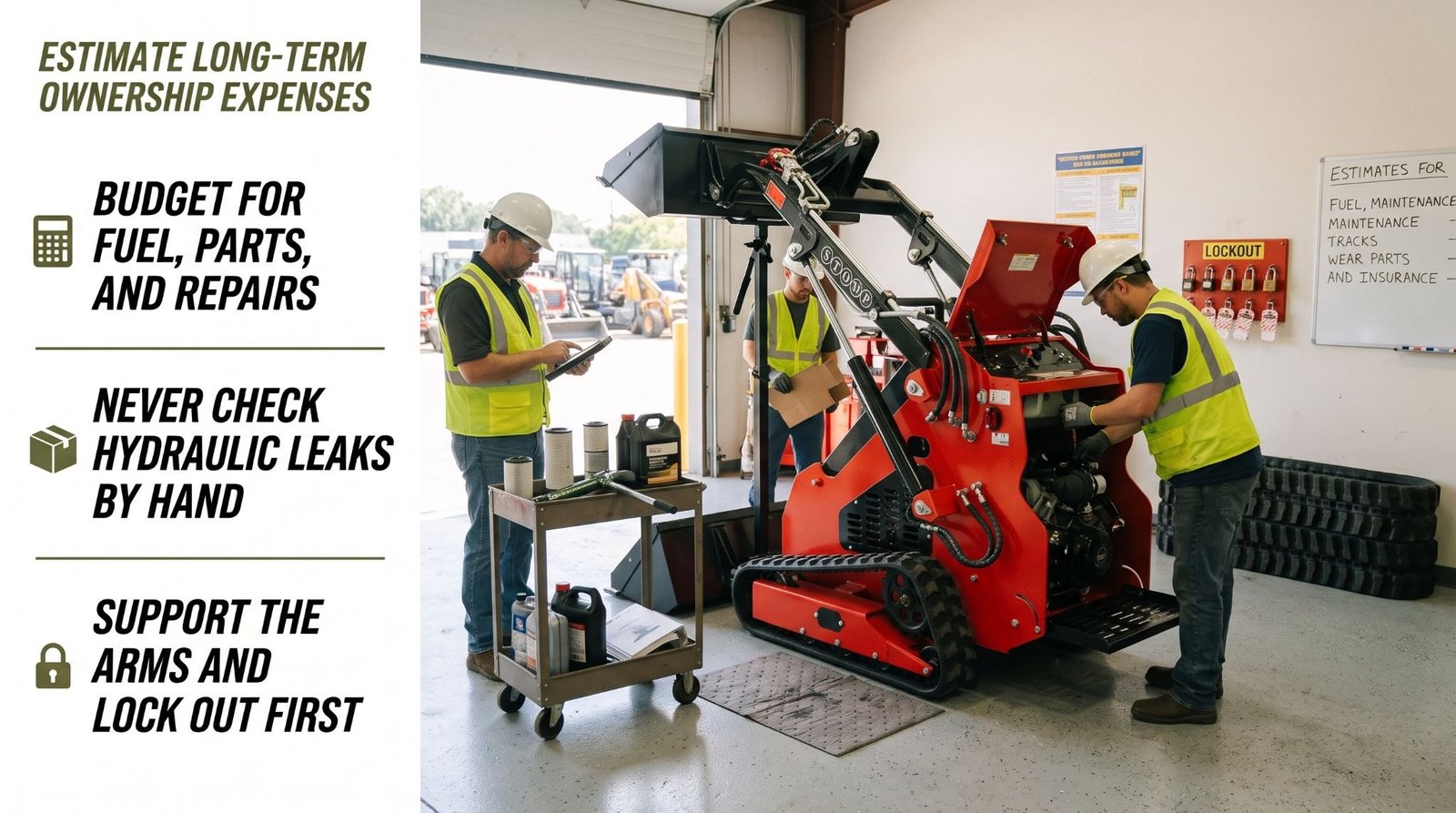
The purchase price is a one-time cost. Ownership expenses continue every year the machine works. For a mid-size skid steer working 600 hours per year, fuel at 3 gallons per hour and $4.00 per gallon costs about $7,200 annually. Add roughly $2,000 for scheduled maintenance, oils, and filters, $1,500 for tire or track wear, $1,500 for wear parts and minor repairs, and $1,500 for insurance, and estimated annual operating cost reaches about $13,700, or roughly $22.80 per hour before financing, depreciation, and operator labor. Your numbers will vary with fuel prices, workload, terrain, and machine size, but building this estimate helps you price jobs accurately and compare machines on more than purchase price.
Consistent maintenance reduces repair costs and preserves resale value. Follow the manufacturer’s service schedule, shorten intervals in dusty or high-heat conditions, and check engine oil, coolant, and hydraulic oil levels daily. Inspect the air filter, clean radiator and hydraulic cooler screens, check hoses and couplers for leaks, and inspect tires or tracks and the attachment plate at the start of every shift. Check coolant only when the engine is cool and never open a hot pressurized cooling system. Use cardboard or wood to check for hydraulic leaks, never your hands.
Before any maintenance or repair, park on firm, level ground, lower the attachment fully, shut down the engine, remove the key, apply your personal lock and tag, and relieve hydraulic pressure as the manufacturer instructs. Use the approved lift arm support device if the arms must remain raised, and verify isolation before starting work. Never bypass the seat bar, operator presence system, or interlocks, and never work beneath raised arms held only by hydraulics. Record operating hours, fluid changes, filter replacements, inspections, and repairs. Good records help you spot recurring problems, plan service during slow periods, support warranty claims, and protect resale value.
Key takeaway: Estimate fuel, maintenance, wear parts, insurance, repairs, and downtime before buying. Follow the service schedule, check leaks with cardboard, lock out before every service task, and keep detailed maintenance records to protect uptime and resale value.
Conclusion
Skid steer costs in 2026 go well beyond the price on a quote. New machines range from about $15,000 for compact models to $120,000 or more for high-end units, while used machines span roughly $5,000 to $85,000 or more depending on condition and configuration. Engine and hydraulic specifications determine which attachments the machine can run, and those attachments can add thousands of dollars to the working investment. Financing terms, delivery, fuel, maintenance, insurance, repairs, and downtime all shape the true cost of ownership.
Frequently Asked Questions
What determines the price of a skid steer in 2026?
Rated operating capacity and machine size set the general price category. Compact models typically cost $15,000 to $30,000, mid-size models $30,000 to $70,000, and high-end models $65,000 to $120,000 or more. Engine power, hydraulic configuration, cab and control options, wheels or tracks, brand, and condition all move the price within those ranges. Regional pricing and dealer terms also affect the final quote.
Is a used skid steer a good investment?
It can be, when the machine’s condition supports its price. Used skid steers generally sell for $5,000 to $85,000 or more. Review maintenance records and operating hours, and inspect the engine, hydraulics, lift arm pins, drive system, tires or tracks, attachment plate, and operator protection. Check for leaks with cardboard rather than your hands, and include upcoming repairs in your comparison with a new machine.
Do skid steer attachments increase the total purchase cost?
Yes. A basic package of a bucket, pallet forks, a grapple, and an auger can easily exceed $10,000, while specialized high-flow tools such as forestry mulchers can cost $20,000 to $50,000 or more. Some attachments also require high-flow hydraulics, which adds to the machine’s price. Confirm mounting, weight, flow, pressure, and connection compatibility before buying any attachment.
What expenses should be included in a skid steer budget?
Include the purchase price, attachments, taxes, financing interest and fees, and delivery or trailer costs. Then add annual operating expenses such as fuel, oils and filters, tires or tracks, wear parts, insurance, storage, repairs, and downtime. Compare the total with rental rates of $200 to $500 per day, $800 to $1,500 per week, or $2,000 to $4,000 or more per month, and lease payments of roughly $900 to $1,000 per month, to choose the most cost-effective option.