Forklift vs. Scissor Lift for Industrial Warehouses, Material Handling, and Jobsite Safety
A third-party logistics warehouse is halfway through a busy night shift when two problems surface at once. In aisle 14, a high-bay light has failed above the pick face. A picker suggests the quickest fix: put a pallet on the forklift’s forks, stand on it, and have the driver raise him up to swap the fixture. At the other end of the building, a maintenance technician has been asked to restock a mezzanine with cartons of spare parts. The scissor lift is already parked nearby, so someone proposes loading the boxes onto its platform and raising them to the mezzanine edge. The shift supervisor stops both plans. The lighting job waits for a scissor lift and a trained operator. The cartons go up on a forklift to an approved landing point. Both tasks finish safely, and neither machine is used for work it was never designed to do.
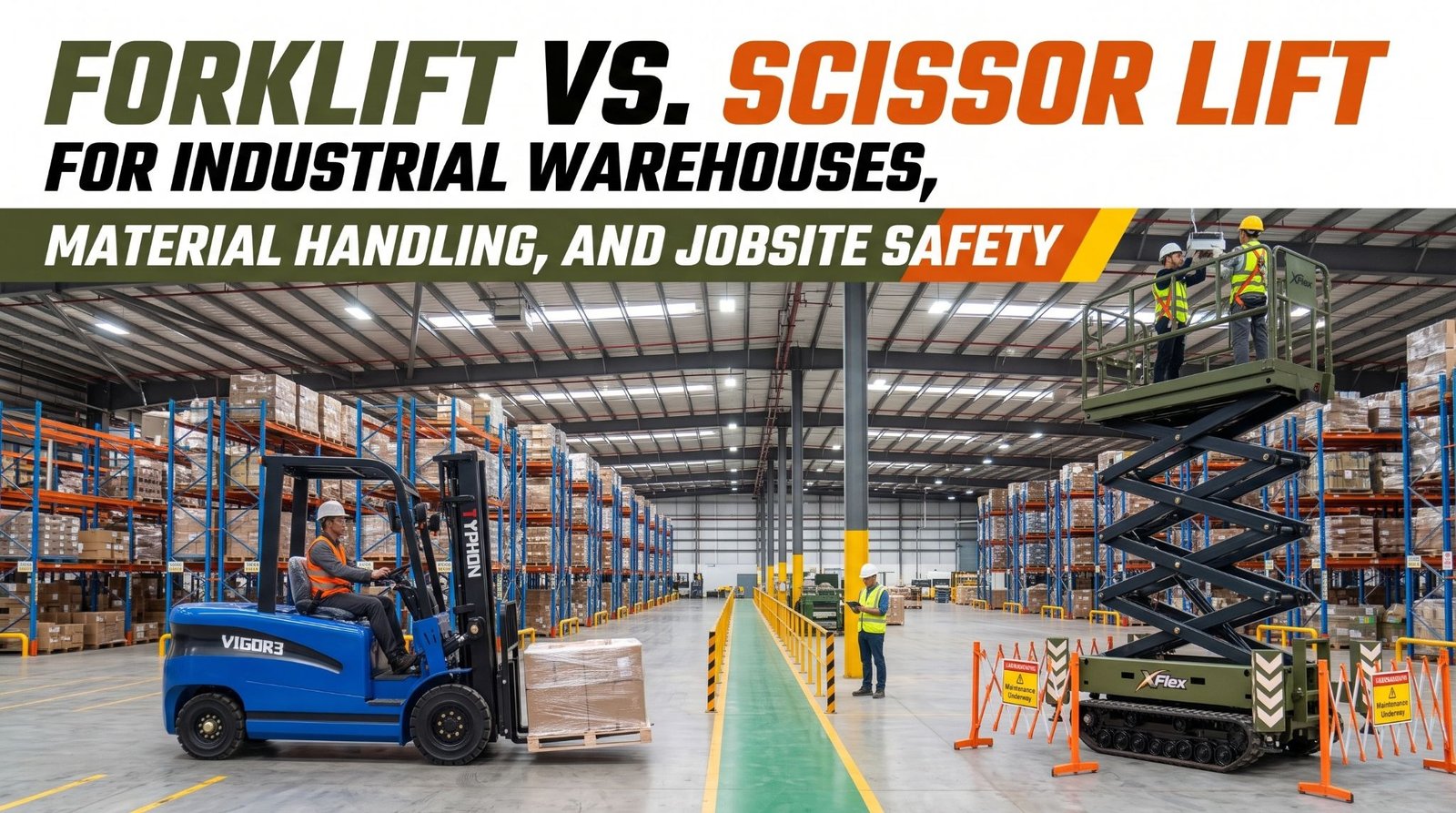
Forklifts and scissor lifts are two of the most common machines in industrial warehouses, distribution centers, manufacturing plants, and construction sites. Both raise things off the floor, which is why they are sometimes treated as interchangeable. They aren’t. A forklift is built to lift and transport loads. A scissor lift is built to raise people, their tools, and permitted materials to an elevated work area. Each machine has its own capacity ratings, dimensions, safety systems, and training requirements. When facilities match each machine to the task it was designed for, work moves faster, inventory stays protected, and crews go home safe. When the lines blur, the risks rise quickly.
Material Handling Versus Elevated Access
The clearest way to separate these two machines is to ask one question: what is being lifted? If the answer is a load, the job belongs to a forklift. If the answer is a person who needs to work at height, the job belongs to an aerial work platform such as a scissor lift.
A forklift lifts and transports compatible loads using forks or approved attachments. Its mast raises and lowers the carriage, its tilt function stabilizes the load, and its counterweight or outrigger design balances the weight being carried. Common forklift tasks include moving pallets between receiving, storage, and shipping areas; stacking and retrieving loads from racking; loading and unloading trucks and trailers; placing materials on mezzanines and elevated landings designed to receive them; and handling specialized loads with approved attachments. Every part of a forklift’s design focuses on controlling a load. Nothing about standard forks or pallets is designed to protect a person standing on them.
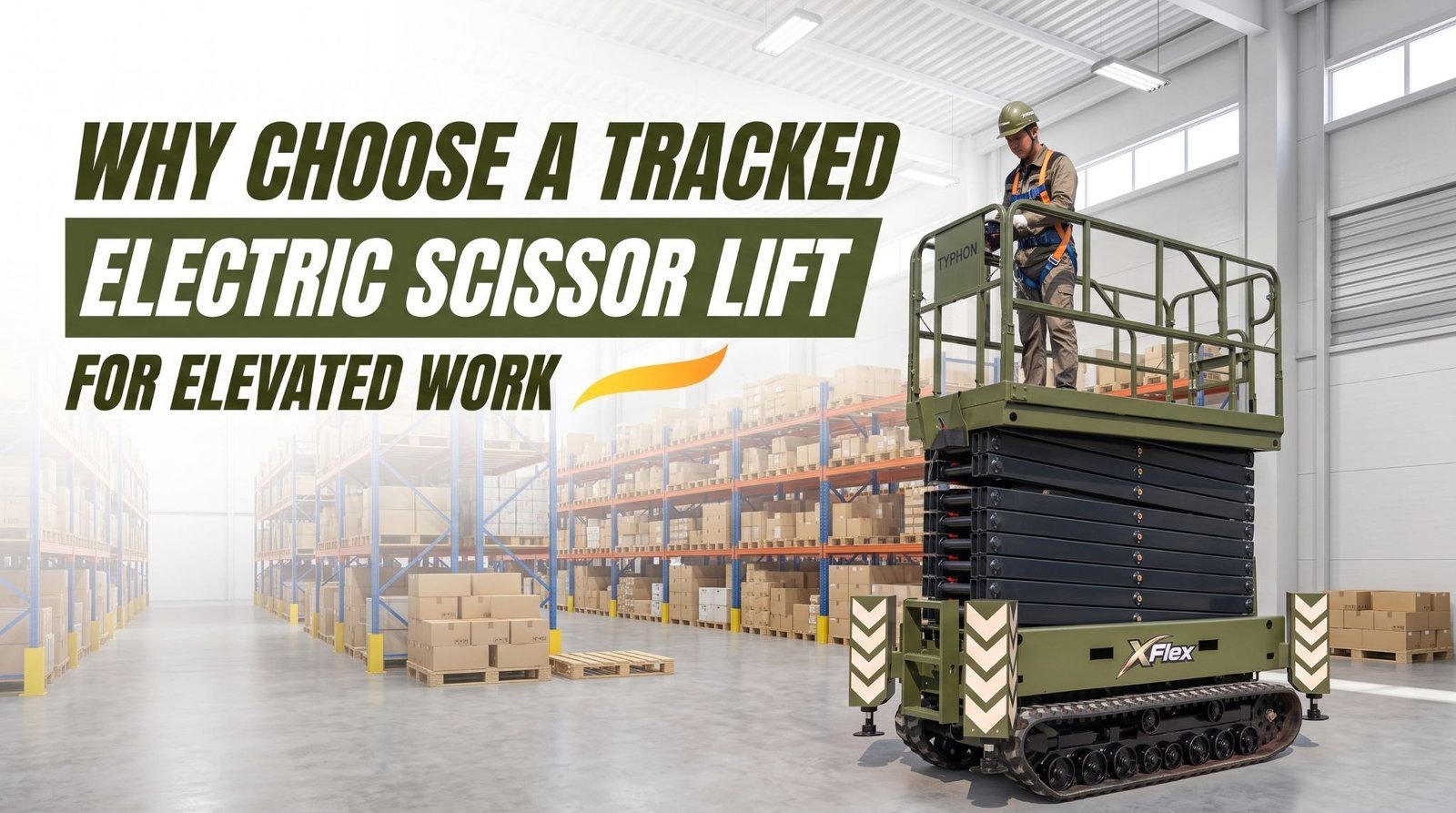
A scissor lift raises a guarded work platform straight up over its chassis. The platform carries workers, their tools, and permitted materials to an elevated work area. Common scissor lift tasks include replacing lighting fixtures and ceiling-mounted sensors, inspecting and servicing sprinkler systems and ductwork, installing signage and overhead fixtures, performing maintenance on overhead doors and building systems, and completing drywall, painting, and ceiling work during construction or fit-out. A scissor lift’s guardrails, entry gate, platform controls, and emergency systems all exist to protect the people on the platform. Its deck is not designed to serve as a material transfer device for pallets or stored goods.
The two machines differ in almost every meaningful way. A forklift’s primary purpose is to lift and transport loads using a mast and carriage, with the operator seated or standing at controls on the truck itself. Its key protections are the overhead guard, seat belt, and load backrest. A scissor lift exists to raise workers to elevated work areas, with the operator riding on the guarded platform. Its key protections are the guardrails, entry gate, emergency lowering system, and alarms. Identify what needs to be lifted first, then assign the machine designed for that purpose.
Operator Training and Safety Systems
The machine is only as safe as the person operating it. Forklift operators and scissor lift operators face different hazards, rely on different safety systems, and need different training. Neither qualification substitutes for the other.
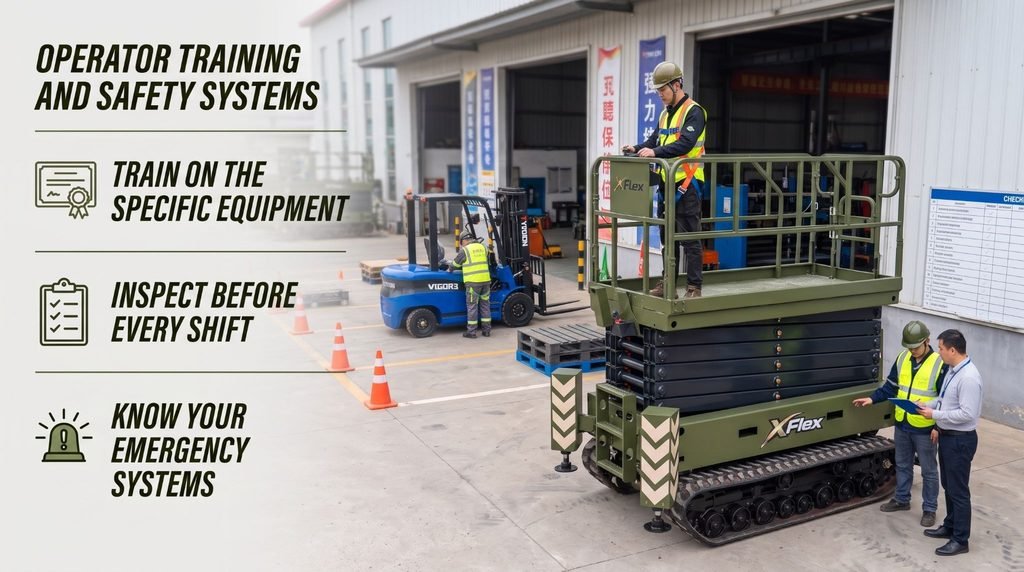
Forklift operators control a heavy machine carrying a load that can shift, fall, or tip the truck. Their responsibilities include confirming load weight and center before each lift, using correct fork spacing and carrying loads low during travel, managing visibility by traveling in reverse when a load blocks the forward view, following designated aisles and observing speed limits, watching for pedestrians and sounding the horn at blind spots, traveling with the load upgrade on ramps, confirming trailer restraints and dock plates before entering trailers, and wearing the seat belt on every operation. In the United States, forklift operators must be trained and evaluated before operating powered industrial trucks, with training covering the specific truck type and workplace conditions.
Scissor lift operators work on the platform they control, often at height and near overhead structures. Their responsibilities include confirming guardrails are secure and the entry gate closes properly before elevating, testing platform and ground controls and emergency stops before use, calculating the combined platform load and respecting occupant and extension deck limits, treating any tilt or overload alarm as a firm stop, and confirming level, firm ground while watching for entrapment hazards as the platform rises. Operators must also consider the machine’s operating weight and battery demand when assessing site conditions, floor load capacity, and daily work requirements. They must be trained in aerial work platform operation and familiarized with the specific model, covering controls, capacity limits, emergency lowering, alarms, and configuration-specific restrictions.
Before each shift, both machines require a thorough pre-use inspection covering structure, controls, safety devices, capacity markings, power system, fluid levels, and tires or wheels. Tag out any machine with a defect that affects safe operation and report it according to the site’s maintenance procedure. A qualified forklift operator is not automatically qualified to operate a scissor lift, and a trained scissor lift operator is not automatically qualified to drive a forklift. Keep training records for every operator and every machine type.
Load Capacity and Platform Limits
Both machines carry capacity ratings, and both ratings must be respected on every lift. The ratings describe completely different things, however. Using one machine’s figures to judge the other, or assuming a high number on one means flexibility on the other, is a serious mistake.
A forklift’s rated capacity is listed on its data plate and depends on specific conditions, including load weight, load center, mast type, lift height, and attachments. A load that is safe at ground level may exceed capacity when raised to the top of a rack. Always check the rating for the forklift’s actual configuration.
A scissor lift’s rated platform capacity appears on its capacity decal and covers the combined weight of all occupants, PPE, tools, equipment, and permitted materials. Check the maximum occupant limit and any separate extension deck or indoor and outdoor capacity restrictions.
These ratings are not interchangeable. Forklifts are designed to handle materials, while scissor lifts are designed to elevate people. Before operation, verify the forklift’s capacity at the required lift height and load center, or calculate the total platform load against the scissor lift’s rated capacity. If either load approaches its limit, reduce the load and make additional trips.
Warehouse Aisles and Maneuverability
A machine with the right purpose and capacity still has to fit the space. Warehouses combine narrow aisles, tall racking, low doorways, overhead systems, and active traffic. Forklifts and scissor lifts respond to these constraints differently.
Forklifts need sufficient space to travel, turn, and position loads safely. Check right-angle stacking aisle width, turning radius, lowered mast height for doorway clearance, and extended mast height for overhead obstructions such as lights and sprinklers. Also allow extra clearance for long or wide loads that extend beyond the truck’s dimensions. Counterbalance forklifts generally require wider aisles, while reach trucks and narrow-aisle models suit tighter warehouse layouts.
Scissor lifts need space to travel and elevate without contacting racks, ceilings, or other obstacles. Key considerations include overall width to fit doorways and aisles with a clearance margin, stowed height to clear door headers and overhead conveyors during travel, turning radius at corners, overhead clearance at the work position accounting for guardrail height above the platform, and clearance from racking since the platform rises straight up and must not contact rack beams or stored goods.
Overhead structures create risks for both machines. A raised forklift mast can strike sprinkler heads, lights, and beams. A rising scissor lift platform can trap workers between the guardrail and a structure overhead. Before operating, identify beams, sprinkler heads and branch lines, light fixtures and cable trays, overhead doors, and conveyors. Raise loads and platforms slowly near overhead structures. On scissor lifts, keep heads and hands inside the guardrails at all times.
Both machines also depend on the floor beneath them. Forklifts carrying heavy loads concentrate weight on the front axle, while scissor lifts concentrate weight through small tire contact areas. Confirm that slabs, mezzanines, and elevated decks are rated for the machine plus its full load, that floors are firm, level, and within the manufacturer’s slope limits, and that drains, dock plates, and pits are identified or barricaded. Clear debris, shrink wrap, banding, and spills before operation, and keep dock edges and loading ramps clearly marked.
Indoor Air Quality and Power Source
Most warehouse work happens indoors, often around people who spend entire shifts in the building. Power source decides what each machine releases into that shared air, and it shapes where each machine can operate.
Electric forklifts and electric scissor lifts produce no exhaust emissions at the point of use, making them well suited to enclosed warehouses, cold storage, food and beverage facilities, pharmaceutical operations, and retail environments. Electric equipment also runs more quietly, which supports communication between operators and pedestrians. Electric power brings its own requirements, including properly sized and located charging areas, ventilation for lead-acid battery charging due to hydrogen gas release, appropriate eyewash and safety equipment where battery maintenance is performed, and charging schedules that keep machines available when crews need them. Lithium-ion batteries often support opportunity charging and require no watering, which can simplify multi-shift operations.
Forklifts and some aerial work platforms are also available with LPG, gasoline, dual-fuel, or diesel engines. These power types produce exhaust that can contain carbon monoxide, nitrogen oxides, and other pollutants that build up in enclosed spaces. Combustion-powered equipment may only be used indoors where ventilation, air monitoring, emissions controls, and site requirements permit. Before any combustion-powered machine enters a building, confirm the facility’s ventilation capacity, site rules and customer requirements, applicable workplace exposure regulations, the manufacturer’s guidance for indoor use, and fuel storage and refueling procedures.
Electric machines are quieter, which helps workers communicate but also means pedestrians may not hear a forklift approaching. Use horns at intersections and blind corners, keep warning lights and blue or red zone lights in working order where fitted, and maintain clearly marked and separated pedestrian walkways.
Choosing Equipment for the Task
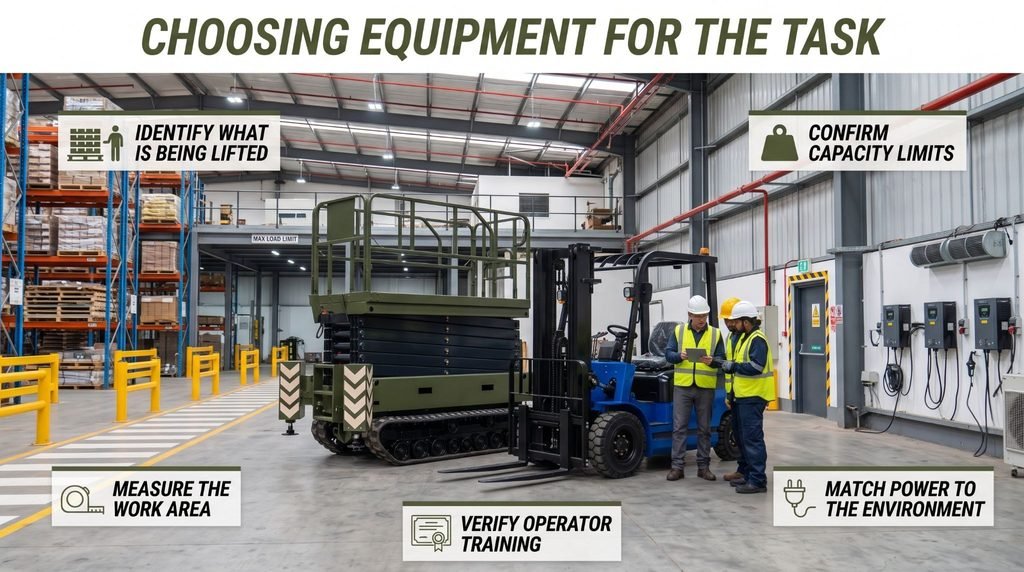
With the differences clear, the right choice usually becomes obvious. Assign each task to the machine designed for it, and plan how the two machines work together when a job needs both. Before every assignment, identify what is being lifted and use a forklift for loads and a scissor lift for elevated personnel access. Confirm capacity limits on the data plate or capacity decal for the exact machine and configuration. Measure the work area and compare machine dimensions with aisles, doorways, overhead clearances, and floor ratings. Match the power source to the environment, using electric equipment indoors where possible and confirming ventilation and site approval for other power types. Verify that operators are trained and familiarized on the specific machine before assigning it.
Forklifts handle material transport, pallet unloading, warehouse storage, and placing loads on approved mezzanine landings. Scissor lifts are designed for elevated work involving people, such as replacing lighting, inspecting sprinklers, and installing overhead signage or conduit. For tasks requiring greater horizontal outreach, a boom lift may be more suitable.
Some projects require both machines to work together. For example, a forklift can deliver lighting materials to a floor-level staging area, while a scissor lift carries workers and permitted materials to installation points. Plan material staging, barricade elevated work areas, keep forklift traffic clear, establish communication signals, and schedule work during quieter periods to maintain a safe and efficient operation.
Never lift workers on forks, pallets, or improvised platforms. Never use a scissor lift platform to move pallets or inventory. Never hang materials or tools from scissor lift guardrails. Never raise a forklift load near workers on an elevated platform. Never operate either machine without training on that specific equipment.
Conclusion
Forklifts and scissor lifts perform complementary roles in warehouses, distribution centers, and construction environments. Forklifts are designed to lift and transport loads, with rated capacity affected by load weight, load center, mast configuration, lift height, and attachments. Scissor lifts elevate workers, tools, and permitted materials to overhead work areas, with platform capacity accounting for everyone and everything on the deck. These ratings are specific to each machine and cannot be used interchangeably. Both equipment types must also fit the available aisles, doorways, and overhead clearances while meeting site floor and operating requirements. Electric models are suitable for many indoor applications because they produce no exhaust at the point of use, while other power types require appropriate ventilation and site approval. Machine-specific operator training and thorough pre-use inspections are essential for safe operation. Facility managers should identify routine material handling and elevated access tasks and assign each to the appropriate equipment. Measuring narrow aisles, low doorways, overhead clearances, and floor load limits helps confirm site compatibility. Training records should be reviewed for every machine model, with clear procedures established for equipment staging, traffic separation, and crew communication. Proper coordination allows forklifts and scissor lifts to operate alongside each other while remaining within their intended functions.
Frequently Asked Questions
Can a forklift be used as a personnel lift?
Only when an approved work platform designed for that purpose is used, secured to the forklift, and operated according to the manufacturer’s instructions and applicable requirements. Ordinary forks and pallets must never be used as improvised platforms. For most overhead work, a scissor lift or other aerial work platform is the safer, more practical choice.
Can a scissor lift move warehouse pallets?
No. A scissor lift is not a replacement for a forklift. Its platform is designed for personnel and permitted tools or materials within its rated capacity. Use a forklift to move, stack, and place pallets, and keep materials on a scissor lift limited to what the work at height requires.
Which machine is better for overhead warehouse maintenance?
A suitable scissor lift is often the right choice when workers need a stable, guarded elevated platform for lighting, sprinkler, ductwork, or ceiling work. Its platform height, capacity, and dimensions must match the task and site conditions. When work sits above racking or fixed equipment, a boom lift may be more suitable.
What safety checks apply to both machines?
Inspect the equipment before each use, verify capacity limits on the data plate or capacity decal, and check the work area for overhead hazards, floor conditions, and pedestrian traffic. Confirm that operators are trained on the specific machine, and follow the manufacturer’s operating instructions and site safety procedures. Tag out and report any defect before use.