
Mini Excavator Mechanical Control, Hydraulic Control, and Machine Response
Excavation work often requires operators to perform precise movements across different functions, including boom lifting, arm extension, bucket curling, swinging, blade adjustment, and travel. The way a mini excavator responds to joystick or lever input affects how smoothly these tasks can be completed. Selecting a suitable control system is especially important when operators have different levels of experience or must switch between machines.
Mechanical and hydraulic pilot controls transmit operator input through different systems, influencing lever effort, responsiveness, precision, and maintenance requirements. Mechanical controls use physical linkages to operate the control valve, while hydraulic pilot systems use hydraulic pressure to direct valve movement. Overall machine response also depends on the control valve, hydraulic pump, engine speed, and the condition of the hydraulic components.
Choosing the right setup requires comparing control characteristics with the operator’s experience and the precision required for the job. Operators should confirm the machine’s control pattern, learn the function of each lever and pedal, and test the response in a clear, safe area before starting work. Understanding the hydraulic system and following the manufacturer’s operating instructions help maintain accurate movements and reduce the risk of unintended machine operation.
How Mechanical Control Systems Work
A mechanical control system connects the operator’s levers directly to the spools in the excavator control valve. When the operator moves a lever, a rod, linkage, or cable pushes or pulls a valve spool. That spool opens passages that send hydraulic oil to the boom, arm, bucket, swing, or other function. Releasing the lever lets centering springs return the spool to neutral, and the function stops.
Mechanical mini excavator controls are most common on micro and smaller compact machines, and on older models. Many machines under about 2 tons still use direct mechanical levers for some or all functions, since the design keeps cost and complexity down. Some machines combine approaches. They may use mechanical levers for the blade, travel, or auxiliary circuit, and pilot controls for the main digging functions. Check which functions on each model use a mechanical control system before you compare machines.
The direct connection gives mechanical controls a distinct character. The operator feels the spool’s centering spring and some resistance from the valve through the lever, which some experienced operators describe as a closer connection to the machine. Lever effort is usually higher than with excavator joystick controls on a pilot system, and travel distances are often longer. On a long shift, that added effort can contribute to hand, wrist, and forearm fatigue, which affects excavator operator comfort and precision late in the day.
Mechanical systems can be simpler in certain areas. They don’t need a pilot pump, pilot valves, accumulator, or pilot hoses, so there are fewer hydraulic components in the cab area. Their performance, however, depends heavily on linkage condition. Worn pivot pins, loose clevises, stretched cables, and bent rods create play, which makes the mini excavator machine response feel vague or delayed. Dirt and corrosion at pivot points can make levers stick or return slowly to neutral.
Adjustment matters as much as wear. Linkages must be set so each spool reaches full stroke and returns fully to neutral. A linkage that’s slightly out of adjustment can limit a function’s maximum speed or let it creep when the lever is released. Follow the manufacturer’s adjustment procedure, lubricate pivot points at the specified intervals, and inspect boots and cables for damage. Never adjust linkage while the engine is running or the attachment is raised.
When evaluating a used machine with a mechanical control system, operate every lever slowly through its full range. Confirm that each function starts smoothly, reaches full speed, and stops cleanly when the lever returns to center. Look for excessive free play, binding, or lever positions that don’t match between similar functions.
Key takeaway: A mechanical control system links levers directly to the excavator control valve through rods or cables. It offers a direct feel and fewer pilot components, but higher effort and performance that depends on linkage condition and adjustment.
How Hydraulic Pilot Control Systems Work
Hydraulic pilot controls separate the operator’s hand from the main valve. Moving a joystick doesn’t push the main spool directly. Instead, it opens a small pilot valve in the joystick base, which sends low-pressure oil to the end of the corresponding spool in the excavator control valve. That pilot pressure shifts the spool, and the main hydraulic system moves the function.
Pilot valves are proportional. The farther the operator moves the joystick, the more pilot pressure reaches the spool, and the farther the spool shifts. A small joystick movement produces slow, precise motion, and full deflection produces full speed. That proportional behavior is why excavator joystick controls on a pilot system feel smooth and light. Effort usually depends on the joystick’s internal springs rather than the main valve, so operators can work long shifts with less fatigue.
Pilot controls also make control layout more flexible. Because the joysticks connect to the valve through hoses rather than rods, manufacturers can place them on armrests, consoles, or seat-mounted pods. Many machines with hydraulic pilot controls also include a pattern change valve, which lets the owner switch between control patterns without rebuilding linkages. Some newer compact excavators use electro-hydraulic joysticks, which send electronic signals to valves that create pilot pressure. These systems can add adjustable response curves and speed settings.
Safety features are built into the pilot hydraulic system. Most machines have a pilot control lockout, often a lever or console that must be lowered before the joysticks work. Raising it cuts pilot pressure so an accidental bump can’t move the machine. Always raise the lockout before leaving the seat, lowering a window, or letting anyone approach the machine. Lower the attachment to the ground first, and remember that an accumulator may still hold enough pressure to move a function after shutdown. Follow the manufacturer’s procedure to relieve pilot pressure before service.
Pilot systems need specific care. Pilot filters, hoses, and fittings must stay clean and leak-free, since contamination can make pilot valves stick or respond unevenly. Check pilot pressure with the correct gauge and test port if response changes, and have qualified technicians handle diagnosis.
Key takeaway: Hydraulic pilot controls use low-pressure signals to shift the main valve spools. They provide proportional, light-effort control and flexible layouts, with a pilot lockout and accumulator that require careful safety practices.
Comparing Operator Feel and Control Response
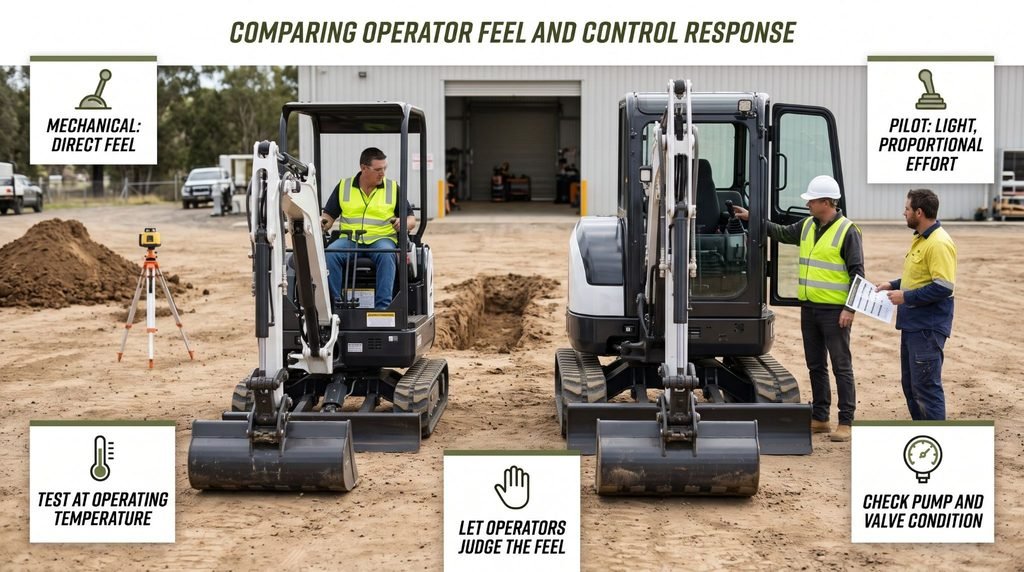
Operators often describe mini excavator controls by how they feel, and feel shapes productivity. Mechanical levers transmit some resistance from the valve, while hydraulic pilot controls offer lighter, smoother movement. Neither system automatically guarantees better precision. The quality of the mini excavator machine response depends on how the entire system is designed, adjusted, and maintained.
Mechanical controls can feel direct. Some operators, especially those who learned on older machines, like sensing the spool through the lever. That feedback can help them judge how far a function is open. On the other hand, higher effort and longer lever travel make fine metering harder for many operators. Worn linkage adds play, which can make slow movements jerky, as the operator in the opening scenario discovered while grading a drain trench.
Pilot controls generally reduce effort and fatigue. Light springs and short joystick travel make it easier to make small, smooth corrections, which supports work such as grading, setting pipe, and digging near utilities. Excavator operator comfort improves over long shifts, and comfortable operators usually stay more precise late in the day. Some operators new to pilot systems find them too sensitive at first, though they typically adapt with practice.
Actual response depends on more than the control type. Valve spool design, metering notches, hydraulic flow, pump output, and control calibration all shape how quickly a function starts and how smoothly it speeds up. Engine speed matters too, since most mini excavator hydraulic pump systems deliver less flow at reduced throttle. Oil temperature has a strong effect. Cold, thick oil makes every function sluggish, so follow the manufacturer’s warm-up procedure before demanding work.
Test each function before you decide. Operate the boom, arm, bucket, swing, blade, and travel at low and full speed, with the machine at normal operating temperature. Try fine movements such as feathering the bucket along a level surface or setting a heavy object gently on the ground. Watch for delays, sudden jumps in speed, or functions that creep when controls return to neutral. Ask your regular operators to run the machine and give honest feedback on predictability and comfort.
Many manufacturers also offer adjustable response settings on newer machines. These may include selectable work modes, fine-control modes, or adjustable joystick sensitivity. Confirm which settings each model provides and how operators change them.
Key takeaway: Mechanical controls can feel direct, while hydraulic pilot controls usually reduce effort and support fine metering. Real response depends on valve design, pump output, engine speed, oil temperature, and condition, so test every function at operating temperature.
How Hydraulic Pump Design Affects Machine Response
The mini excavator hydraulic pump supplies the oil that every control system directs. Controls decide where oil goes, but the pump decides how much is available and how that supply changes with demand. Pump design therefore shapes how the machine distributes power among digging, lifting, swing, and travel.
A gear pump excavator usually relies on fixed-displacement pumps. Each revolution moves a set volume of oil, so flow rises and falls mainly with engine speed. Many gear-pump mini excavators use an open-center excavator control valve. With controls in neutral, oil flows through the valve and back to the tank. When the operator moves a control, the spool redirects oil to the selected function. Excess oil that the function can’t use returns to tank or crosses a relief valve, which creates heat.
Gear pumps offer real advantages. They’re compact, economical, and tolerant of a range of operating conditions. Many manufacturers use two or three gear pump sections to supply separate circuits, which helps maintain independent movement when several functions run together. A well-designed gear pump excavator can deliver predictable, responsive performance for general digging, loading, and backfilling.
A variable-displacement piston pump can change its output while the engine runs at a steady speed. In an axial piston design, a swashplate angle sets how far the pistons travel, and a control system adjusts that angle. Many compact excavators pair a piston pump with load-sensing controls, which supply the flow needed to meet demand plus a small pressure margin. Horsepower or torque limiting reduces pump output as pressure rises, so the pump doesn’t stall the engine during heavy digging.
That ability to adjust output supports refined mini excavator machine response. When the operator meters a function slowly, a load-sensing variable-displacement piston pump reduces flow instead of pushing excess oil across a relief valve. That reduces wasted energy and heat. When several functions run, the pump increases output within its limits. Paired with hydraulic pilot controls and a well-matched valve, it can provide very smooth, proportional control.
Pump type alone doesn’t decide performance. A larger gear pump can deliver more flow than a small piston pump. Valve design, relief settings, cylinder sizes, hose routing, and engine power all influence results. When comparing machines, request pump type, number of pumps, displacement, rated flow, operating pressure, and the engine speed behind each figure. Ask how the pump is controlled, such as load sensing, pressure compensation, or power limiting.
Pump condition affects response as much as pump design. Contamination wears internal clearances, increases internal leakage, and reduces output, especially when the oil is hot. Use the specified fluid, change filters on schedule, and keep coolers clean. If functions slow down, whine, or lose power, have a qualified technician check flow and pressure at the manufacturer’s test ports rather than adjusting relief valves by guesswork.
Key takeaway: A gear pump excavator delivers flow that follows engine speed, while a variable-displacement piston pump adjusts output to demand. Compare pump type, flow, pressure, and control method, and remember that valves, settings, and condition also shape response.
Choosing Controls for Operator Experience and Jobsite Needs
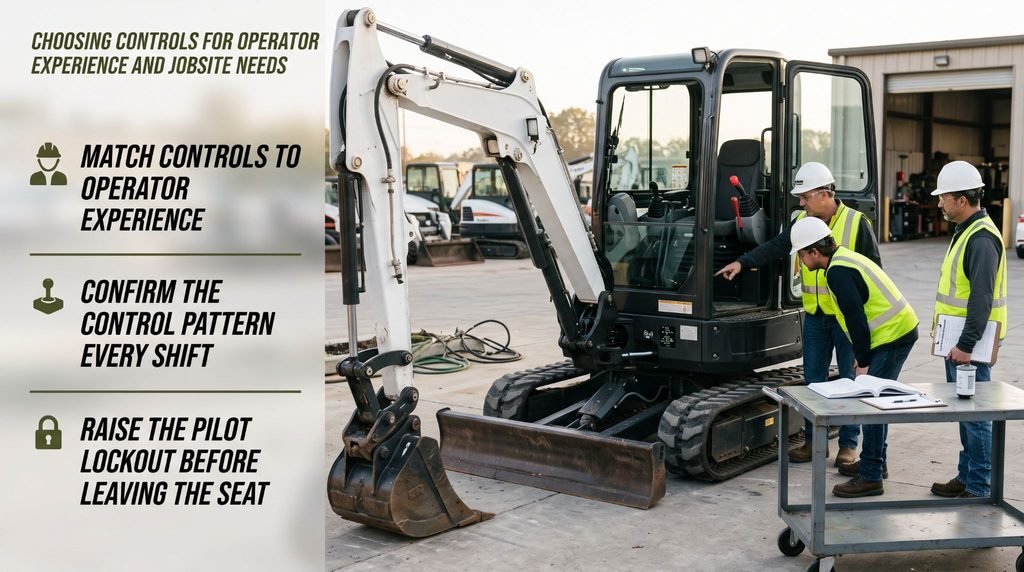
The right mini excavator control system depends on who will run the machine and what work it will do. Operator preference, experience, maintenance support, and task precision all matter. A system that suits one contractor’s crew may frustrate another’s.
Start with your operators. Experienced operators who learned on older machines may be comfortable with a mechanical control system, while operators trained on modern equipment usually expect hydraulic pilot controls. Contractors with several operators sharing one machine may value a familiar layout and easy adjustment. Operators working long shifts often benefit most from the lower effort and better excavator operator comfort of pilot excavator joystick controls.
Match the controls to the work. Precision tasks such as finish grading, setting pipe, exposing utilities, and working near foundations benefit from smooth, proportional control. General digging, loading, and backfilling may be well served by either system. Very small machines used for occasional tasks, such as micro excavators in landscaping or interior demolition, often use mechanical controls to keep size and cost down. Consider the attachments you run, since thumbs, tilt buckets, and augers may require proportional auxiliary controls.
Treat control pattern excavator settings as a safety item. Check the pattern decal in the cab and confirm it matches the actual setting before every shift, especially on rental or shared machines. Follow the manufacturer’s procedure for changing patterns, and change it only with the engine off and the attachment on the ground. Have the operator test each function slowly in a clear area after any change. Never switch patterns partway through a task without telling the crew. Also, inspect key mini excavator cab features, including seat adjustment, joystick layout, visibility, display controls, safety switches, and protective structures. A well-designed cab with comfortable seating, clear sightlines, and accessible controls helps operators maintain accuracy, reduce fatigue, and work safely throughout the shift.
Plan for maintenance and support. Mechanical systems need linkage lubrication, inspection, and adjustment. Pilot systems need clean fluid, pilot filter changes, and attention to hoses and fittings. Ask the dealer about parts availability, technician training, and service intervals for the control system on each model. Request control specifications, including control type for each function, available patterns, and adjustment options, in writing.
Key takeaway: Choose mini excavator controls based on operator experience, task precision, attachments, and maintenance support. Confirm the control pattern before every shift, follow the manufacturer’s procedure for changing it, and train operators on each machine.
Conclusion
Mechanical controls and hydraulic pilot controls operate mini excavator functions through different input systems. Mechanical controls use rods, linkages, or cables to move valve spools directly, while hydraulic pilot controls use low-pressure signals to shift the main control valves, generally requiring less operator effort and supporting smoother, more precise movements. Overall machine response also depends on pump design, control valve configuration, flow sharing, engine speed, hydraulic oil temperature, and system condition. Control patterns are another important consideration, as operators must understand the selected pattern to avoid unexpected movements. When comparing mini excavators, consider operator experience, common job requirements, and the attachments used. Request control type, available control patterns, pump type, flow, and pressure specifications for each model. Test individual functions and combined movements at operating temperature, and confirm the control pattern before operation. Proper evaluation helps you select a machine with predictable response, comfortable controls, and the accuracy needed for safe, productive work.
Frequently Asked Questions
What is the main difference between mechanical and hydraulic pilot controls?
Mechanical controls use physical linkages or cables to move the spools in the excavator control valve directly. Hydraulic pilot controls use low-pressure hydraulic signals from the joysticks to shift the main control valve spools. Pilot systems typically offer lighter effort and proportional response, while mechanical systems provide a more direct feel with fewer pilot components.
Are hydraulic pilot controls easier to operate?
They can provide lighter joystick effort and smooth, proportional response, which many operators find easier over long shifts. Operator preference and system design also matter. Some experienced operators prefer the direct feel of mechanical levers, and actual precision depends on valve design, pump output, and machine condition.
Does the hydraulic pump affect mini excavator control response?
Yes. Pump output and design influence available flow and how hydraulic power reaches each function. A gear pump excavator delivers flow that follows engine speed, while a variable-displacement piston pump can adjust output to match demand. Pump condition, fluid cleanliness, and engine speed also affect response.
What should buyers test when evaluating mini excavator controls?
Test boom, arm, bucket, swing, blade, travel, and combined movements at normal operating temperature, paying attention to smoothness, precision, and operator comfort. Confirm the control pattern and pilot lockout operation before starting. Test with a loaded bucket, and watch for delays, sudden speed changes, or functions that creep when controls return to neutral.